
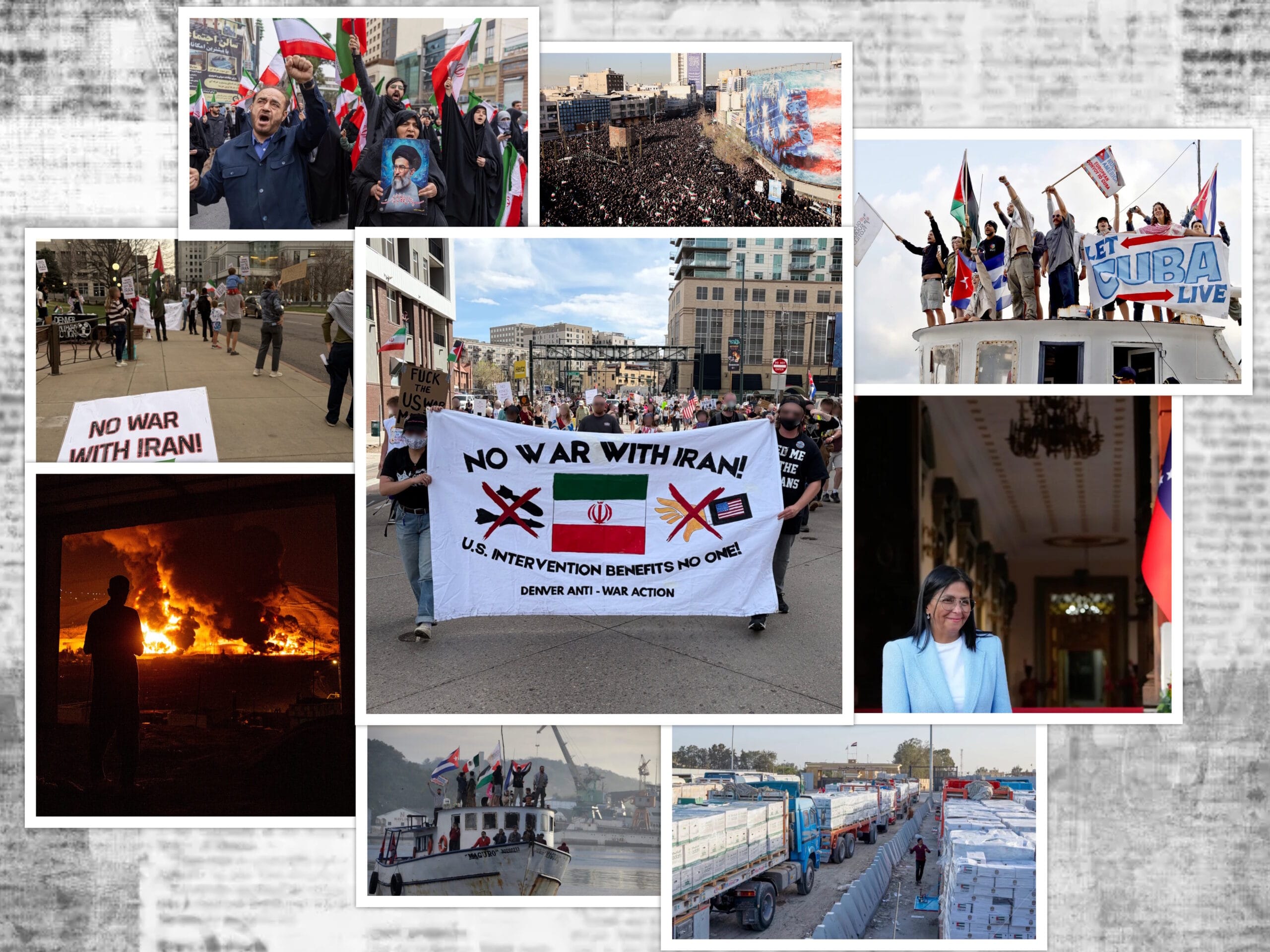
Denver Anti-War Action (DAWA) is a local community organization that opposes U.S. imperialism and the military-industrial complex worldwide. DAWA’s recent activity has largely focused on our campaign targeting Palantir, a software company with customers including the IOF (Israeli Occupation Forces) and ICE (Immigration and Customs Enforcement). However, with Palantir’s move of their global headquarters out of Denver, we are currently working on investigating whether Palantir has any remaining presence in the city as a part of transitioning our focus. If we find that Palantir continues have a presence, we will continue to dedicate energy to remove them completely from our community. As a part of this process, we will continue to dedicate energy and focus on opposing the Iran War in the most recent continuation of U.S. imperialism in the region.
Additionally, as a co-founder of Denver Coalition Against Trump (DENCAT), a coalition with a diverse array of local organizations, DAWA remains committed to fighting Trump’s racist and reactionary agenda.
DAWA’s most recent events include:
- 3/1 – Emergency Protest in Response to US and Israel Strikes on Iran
- 3/3 – Hands off Venezuela and Cuba Rally
- 3/8 – International Women’s Day Rally
- 3/14 – “Good Riddance” Rally
- 3/23 – No War in Iran Rally
- 3/28 – No Kings 3
- 3/30 – Land Day
Upcoming events include:
- 4/18 – Iran Teach-In
Big Tech in Your Backyard: Palantir
On February 28th, during the initial wave of strikes carried out by the United States and Israel against Iran, a missile struck the Shajereh Tayyebeh girls’ school in Minab, killing at least 165 girls, mainly aged between 7 and 12. Recovery of debris has identified components made in the United States including a Boulder, Colorado facility of Ball Aerospace Technologies.
This bombing has since been attributed to outdated satellite imagery referring to the school as part of a nearby military base, which led to the United States’ targeting system recommending it as a target.
After use of their surveillance and AI platforms in Venezuela to aid the United States in the illegal kidnapping of Maduro, Palantir has become a critical component in Trump’s attacks on Iran, with their data collection technologies being used to locate targets. The system utilized is Project Maven, which implements Anthropic’s AI in conjunction with Palantir’s information systems to generate “recommendations” for strikes. Relying solely on algorithms and training data, this has led to concern over the the data used classify a threat.
Additionally, it has increased the speed at which decisions about a strike are made. This is in fact something considered desirable by the military, who in 2024 had the goal of 1000 target decisions per hour in 2024. In the cases of these strike targets, it has transformed the military into a veritable machine of automated terror, with human decision often coming down to just the approval or denial of the AI’s suggestion. Similar systems were used in Israel’s genocide on Gaza under the name “Lavender”.
Though successful in our campaign to drive Palantir out of Colorado, we understand that the fight against big tech is far from over. So long as Palantir is able, they will continue to seek profit by way of perpetuating the US war machine. And so long as they are able to do this, we must be willing to organize, resist, and fight back. Ahead of their relocation to Florida, protests have already begun outside of their new Miami Headquarters. Another, more recent protest occurred in New York City, where protesters staged a die-in.
Palestine Updates
Gaza
On February 28, Israel once again closed the Rafah Crossing in accordance with their renewed siege of the Gaza Strip. This has led to concerns of a looming food and energy shortage during the month of Ramadan. Karuna Herrman, Jerusalem director of the United Nations Office for Project Services, estimated only a couple days left of fuel, while Palestinian aid official Amjad Al-Shawa estimated approximately 3 to 4 days remaining, as of March 3.
This also means Israel is now maintaining closure on all but one opening in the Strip, Kerem Shalom in Southern Gaza. Exit for medical evacuations, as well as return of Palestinians to their homes from abroad, has since been suspended. This has of course led to shortages and soaring prices, and plummeting purchasing power for Palestinians in the Strip. Video footage of markets recorded by Palestinians show completely empty meat fridges, as no meat is making it into the strip, and other food being spread out on shelves in order to appear more stocked. A representative for UNOPS on March 5 stated that one of their tankers was struck by naval forces on its way to refuel for distribution in Gaza. Israel denies involvement in the incident. Rafah was reopened on Thursday, March 19 in both directions, but in an extremely limited capacity. Reportedly only 8 Palestinians were allowed to cross to seek medical aid, while a reported 18,000 people remain in critical condition from injuries and famine. Gaza remains completely dependent on fuel entering the strip, and without that the hospital and water/sanitation systems are at risk.
On Monday, March 9, Palestinian journalist Amal Shamali was killed by an Israeli airstrike on the Nuseirat refugee camp in the Central Gaza Strip. This brings the number of martyred Palestinian journalists to 261. Amal worked for Radio Qatar as a correspondent. He also worked with several Arab and local media outlets, and was among the journalists who continued performing their media mission despite the war on the Gaza Strip becoming the deadliest conflict for journalists in recorded history. In a statement, the Palestinian Journalist Syndicate had this to say: “Targeting journalists will not succeed in breaking the will of the Palestinian journalistic community or deterring it from fulfilling its professional and humanitarian mission of conveying the truth and documenting the crimes and aggression faced by the Palestinian people.”
The same strike killed 12-year old Salsabeel Farraj.
West Bank
Occupation soldiers used a Palestinian-plated vehicle to block the road March 15th, 2026. They used this to stop a car of a Palestinian family returning from Eid shopping outside of Nablus. The occupation solders shot and killed Ali Khaled Bani Odeh, 37, his 35-year-old wife, Waad, and two of their children, Mohammad and Othman, ages 5 and 7, and injured the two surviving children. Khaled, 12, the oldest of those two, recalls his father saying the Shehada, the Muslim declaration of faith, right before the occupation soldier murdered him. After the murderous soldiers beat Khaled and detained him and his only living younger brother in their vehicle, Khaled asked the soldier, “Do you love your mother and father?” The soldier replied “Yes.” Khaled responded, “Then why did you kill my mother and father?” to which the murderer hit Khaled in the face. This is just one story of the 19,000 attacks carried out by occupation forces in the West Bank since the beginning of the calendar year, as reported by Middle East Monitor.
Updates on Massafer Yatta, filming location of No Other Land
Occupation attacks on Palestinian people and homes have increased in 2026, including demolition of residential structures belonging to Palestinians in March 2026, and a massive campaign in January 2026 of livestock theft and arson, often with people still inside the building as it burned. At one point, occupation settlers used a vehicle to block the path of volunteer firefighters from reaching At-Tuwani with a small water tank. Surveillance camera footage shows settlers assaulting 49-year-old Mohammed Abu Sabha, who was preparing to rush to the aid of other residents already under attack to the point of needing urgent medical assistance. The settlers also assaulted Mohammed’s elderly mother, striking her head, breaking her arm, and fracturing one of her ribs, before shattering a window to spray tear gas into the room where the family had taken shelter. Settlers held ambulances and medical workers at gunpoint to keep them from reaching the people who needed care. Soldiers also stole a flock of sheep, beating and tear-gassing the 53-year old woman of the family when she tried to stop them.
Venezuela
Under interim president Delcy Rodríguez, Venezuela’s government continues to deepen ties with the US. On March 5, the US State Department announced that Venezuela and the US had agreed to reestablish diplomatic relations, which have been severed since 2019. Chevron and Shell also made preliminary agreements with the Venezuelan government in early March to expand oil production in the country. On March 9, the Venezuelan National Assembly approved a mining law designed to grant greater concessions to private companies than previous regulations, allowed. However, domestic social policy appears to be progressing much as it was before the US’s illegal abduction of Venezuelan President Nicolás Maduro. On March 8, Venezuela held its first National Popular Consultation of the year, a direct democracy mechanism in which residents of 5,336 communes around the country voted to select local projects to receive state funding.
Venezuela’s main opposition figure is María Corina Machado, a staunch Zionist and vocal supporter of Trump. At the beginning of March, Machado announced her plan to return to Venezuela with the objective of holding and winning a presidential election there. Trump subsequently poured cold water on this plan, telling Machado that she should not return to Venezuela for now. It should be noted that under ordinary circumstances, Venezuela’s next presidential elections are scheduled for 2030. On Tuesday, Machado shared her opinion that Venezuela’s oil reserves should be fully privatized — the dream scenario for multinational oil corporations.
A major shake-up in the country’s leadership was undertaken on March 19, when Rodríguez replaced longtime defense minister Vladimir Padrino López with Gustavo González López, the former head of the Venezuelan military’s intelligence service SEBIN.
Cuba
Cuba has been under US embargoes of varying degrees since 1958, when the US government imposed an arms embargo on the country during the armed phase of the Cuban Revolution. In January, Trump issued an executive order which established a blockade and strong-armed all countries into ceasing oil exports to Cuba. Due to this blockade, the island nation of eleven million has not imported any fuel in three months.
The intensified oil blockade that has created a humanitarian crisis, Cuba’s power grid relies almost entirely on oil for electricity generation. The total lack of fuel imports has already led to a power outage for most of the country in early March, followed by a complete electrical grid shutdown on March 16. Additionally, without fuel, farm produce cannot be transported from the countryside to cities, public transportation grinds to a halt, and municipal services like garbage collection cannot properly operate. This total disruption of essential services has led to rising food prices, garbage pileups in cities, and the severe degradation of medical and educational services.
Since February, Trump has floated the idea of a “friendly” takeover of Cuba by the United States, at times even threatening that “it may not be a friendly takeover”. On March 16, Trump stated that he thinks he will have the “honor” of “taking Cuba”, fantasizing that he could “do anything [he wants] with it”. Cuban President Miguel Díaz-Canel has confirmed that Cuban officials have held talks with the US, but emphasized that Cuba’s political system and the positions of government officials are not up for debate. The details of the talks between Cuba and the US remain unclear. However, Cuba’s deputy prime minister, Oscar Pérez-Oliva Fraga, has indicated that Cuba is open to having “a fluid commercial relationship with U.S. companies” and to allowing Cuban-Americans to make commercial and infrastructure-related investments in Cuba.
Due to Trump’s intensified blockade on Cuba since January, the island nation of eleven million had not imported any fuel in three months — until this week. On Monday, the Russian oil tanker Anatoly Kolodkin arrived at the Cuban port of Matanzas with 730,000 barrels of oil. This amount is estimated to be able to feed Cuba’s demand for diesel for 9-10 days.
Iran
On February 28, the United States and Israel launched a joint military operation consisting of a 12-hour period during which nearly 900 strikes were carried out inside Iran. These strikes followed a massive buildup of military force in the area that began in December, and a 12-day bombing campaign against Iran last June. In response to this escalation, Iran immediately began retaliatory strikes against Israel and U.S. military bases in the region that has resulted in a war that is ongoing to this day.
During the first salvo of strikes, Israeli jets assassinated former Iranian Supreme Leader Ali Khamenei, in addition to top security adviser Ali Shamkhani, IRGC (Islamic Revolutionary Guard Corps) commander Mohammed Pakpour, and several other top officials. Shortly after Ali Khamenei’s assassination, his son Mojtaba Khamenei was selected by Iran’s top clerical body, the Assembly of Experts, as Iran’s new supreme leader. Iran’s President Masoud Pezeshkian has survived the initial and follow-up US-Israeli assaults. The war has been fought primarily through aerial bombardment on the part of US and Israel, and drone and missile bombardment from both sides. Here is a non-exhaustive list of notable targets/victims of US-Israeli attacks over the past month (with the attacker country listed in parentheses):
- Shajareh Tayyebeh Elementary School in Minab, killing 168 people, including over 100 children (US)
- Desalination plant on Qeshm Island in southern Iran (US)
- Iran’s South Pars gasfield, part of the world’s largest natural gasfield (Israel)
- Several oil depots and refineries across Tehran during a single overnight attack, releasing huge amounts of toxic smoke that covered large parts of the city (Israel)
- Bushehr Nuclear Power Plant, Iran’s only operational nuclear power facility, used for the civilian power grid (US/Israel)
- IRGC Ballistic Missile Research Complex in Tehran, Iran (Israel)
- Long-range anti-aircraft missile assembly site in Ghazvin Province, Iran (Israel)
- Research facilities at Imam Hossein University in Tehran, Iran, including wind tunnels and the chemistry and physics centers (Israel)
Iranian retaliatory strikes have hit the following targets during the past month (among others):
- US Navy 5th Fleet Headquarters in Bahrain
- Al-Udeid Air Base in Qatar, the largest US base in West Asia
- Muwaffaq Salti Air Base in Jordan, destroying a THAAD radar system
- Liquefied natural gas (LNG) plants in Qatar, knocking out 17% of the country’s LNG exports
- Amazon data center in the UAE
- A major oil refinery in Haifa, Israel, causing damage to the Israeli power grid
- Prince Sultan Air Base in Saudi Arabia, damaging multiple US KC-135 tankers and an E-3 Sentry radar aircraft
Strait of Hormuz
As part of their asymmetric strategy to put financial pressure on the West, Iran has effectively shut down the Strait of Hormuz. Iran initially stated that any ship passing through the strait would be targeted, and has attacked at least 22 ships passing through the strait so far. The rate of ships passing though the strait, which before the war saw a third of the world’s maritime oil shipments and a fifth of its natural gas shipments pass through it, has dropped from around 50 per day to nearly zero. This has led to surges in the price of oil and natural gas, which in turn has driven increases in the prices of all sorts of other commodities like gasoline. In a move which targets the petrodollar (the system, largely the global status quo, in which oil-exporting countries trade oil for US dollars), Iran has recently announced that they will only allow oil tankers to pass through the Strait of Hormuz if they sell their oil in China’s currency, the yuan.
Lebanon
As part of their campaign of aggression against Iran and its allies in West Asia, Israel began a wave of attacks on Lebanon on March 2. Israel claimed to be targeting Hezbollah, after the group launched drones and rockets into northern Israel in retaliation for the Israeli assault on Iran. However, Lebanon’s civilian population has overwhelmingly suffered the most as a result of the attacks. The attacks have displaced over 800,000 people, more than one-seventh of Lebanon’s population. The same week the Israeli assault began, an Israeli military spokesperson gave an evacuation order (via X/Twitter) for a large section of southern Lebanon amounting to 8% of the country’s territory. Israel soon proceeded to launch waves of airstrikes against the south of Lebanon’s capital Beirut, as well as other major cities like Tripoli. Since the attacks began in early March, Israel has killed nearly 1,100 people in Lebanon and injured over 3,000.
Kharg Island
Trump has recently threatened to attack Iran’s Kharg Island, threatening to destroy all of the oil and energy infrastructure there. Kharg Island is very small, less than five miles across, but it hosts oil terminals and ports through which ninety percent of the country’s crude oil is transported to large tankers for export. Trump has stated that he would like to “take the oil in Iran”, which would likely require the US to seize Kharg Island in a costly invasion. Two groups of US Marines are en route to West Asia — 2,200 from the 31st Expeditionary Unit traveling on the USS Tripoli, and 2,500 from the 11th Expeditionary Unit on the USS Boxer. It is possible that these units, which are amphibious assault units that are trained to invade a region by sea, could be used for a proposed US invasion of Kharg Island. This would represent a significant escalation against Iran for, as always, the benefit of the ruling classes of the US and its allies, and the detriment of essentially everyone else.
The US-Israeli war on Iran and its people is the most significant geopolitical development of the year so far, and new information is coming out rapidly. Further information beyond this update will be forthcoming from DAWA.
Wins
As the United States imposes a complete blockade on Cuba, a group of activists organized a grassroots campaign to send convoys of humanitarian aid to Cuba. The first boat of the Nuestra América Convoy (Our America Convoy) broke through the blockade and arrived to Cuba on Tuesday, March 24th, with solar panels, medicine and medical items, bicycles, food and baby formula. As the convoy entered the harbor they chanted “Cuba sí! Bloqueo no!”
“These ships are a drop in an ocean of need,” Brazilian activist Thiago Avila has acknowledged, further stating that “At the same time, it’s a gesture of solidarity.” The boats name is the Granma 2.0 in reference to the ship 82 Cuban revolutionary fighters–including Fidel Castro and Che Guevara–used to sail from Mexico to Cuba in 1956 to overthrow the US-backed dictator Fulgencio Batista, the Granma. This act of international solidarity show that “the free people of the world will never abandon Cuba [and] that Cuba is not alone.” [Avila].
As the war against Iran continues, more and more U.S. soldiers are filing for conscientious objector status. This means that service members are objecting to participating in the war in any form. Data shows that conscientious objector clients has increased 1,000% since the beginning of this war, percentages that are higher than they have ever been, even throughout the Iraq War and the Afghanistan War. This surge shows that opposition to this war even reaches into the military.