
Denver Anti-War Action (DAWA) is a local community organization that opposes U.S. imperialism and the military-industrial complex worldwide. DAWA’s recent activity has largely focused on our campaign targeting Palantir, a software company with customers including the IOF (Israeli Occupation Forces) and ICE (Immigration and Customs Enforcement). However, DAWA continues to be in a transition phase following the win of Palantir moving their global headquarters out of Denver. Additionally, as a co-founder of Denver Coalition Against Trump (DENCAT), a coalition with a diverse array of local organizations, DAWA remains committed to fighting Trump’s racist and reactionary agenda. As a part of this, DAWA continues to devote energy opposing U.S. imperialism such as the Iran War and the blockade of Cuba.

Recent Actions
- 4/8 – Emergency Iran Action
- 4/10 – Action + Call-In to Michael Bennett
- 4/14 – Space Symposium Action
- 4/15 – Tax Day AWAN Banner Drop
- 4/16 – CU Boulder ICE, IOF and Palantir Panel
- 4/18 – Iran Teach-In
- 5/1 – May Day action
Upcoming Actions
- TBD – Hawaii Action

Big Tech in Your Backyard: Palantir
With Palantir’s Project Maven rapidly rolling out across the US Department of Defense after its use in the attacks on Iran earlier this year, this month we have provided an analysis of the project, focusing on its history, the dangers it poses both within the United States and abroad, and how it may fit within the long history of the use of new technology to make US aggression against the world deadlier, faster, and more destructive.
Given the length and scope of this write-up, we have elected to publish it separate from the newsletter as its own article, which can be read here.
We hope that this may provide much-needed clarity around Project Maven and Palantir’s involvement, and reaffirm that no matter the software systems imperialism runs on, it cannot defeat the power of people united in its opposition.

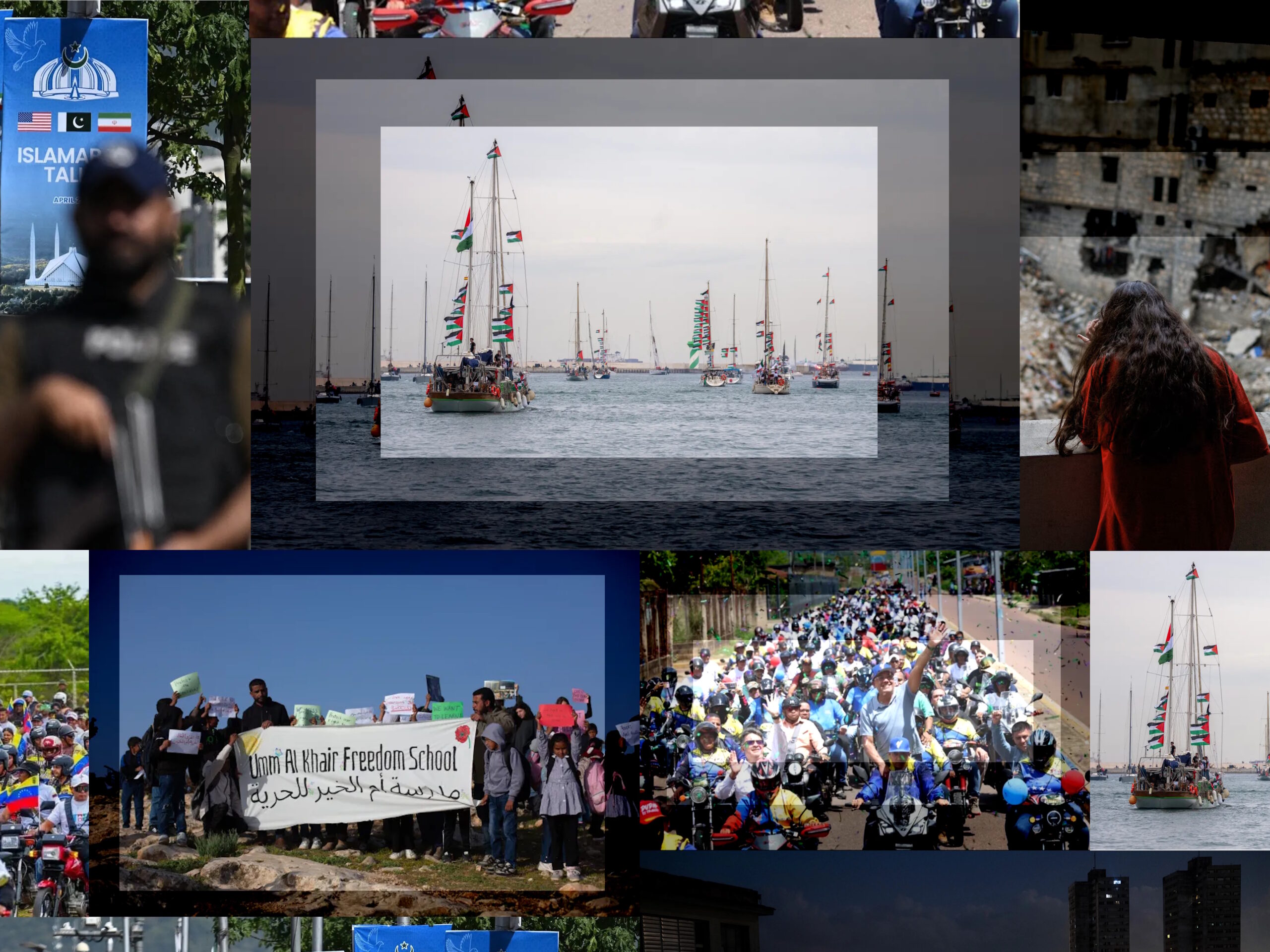
Security personnel stand guard at a checkpoint in the Red Zone area in Islamabad on April 20, 2026, ahead of U.S.-Iran peace talks mediated by Pakistan. Aamir Qureshi/AFP/Getty Images. cfr.org
Iran
The US-Israeli War on Iran that began on February 28 of this year raged on during the first week of April. The US bombed and destroyed the B1 Bridge in Karaj, Iran, which is the largest bridge in West Asia and a vital link on one of the country’s major highways. On April 3, Iran shot down a US F-15 fighter jet over the country, prompting a search effort for both crew members which, though successful, saw multiple US aircrafts destroyed. On April 7, Trump threatened via Truth Social that “a whole civilization [would] die tonight” if Iran didn’t make a peace agreement with the US.
The next day, April 8, Trump abruptly backed off from his threats and announced that the US would agree to a two-week ceasefire with Iran in exchange for Iran opening the Strait of Hormuz. A ten-point plan proposed by Iran would form the basis for negotiations around the ceasefire, which contained provisions including the lifting of primary and secondary sanctions on Iran, acceptance of Iran’s nuclear enrichment rights, and cessation of hostilities in the war on all fronts, including in Lebanon.
Just hours after the Iran-US ceasefire was announced, Israel carried out its largest coordinated strikes against Lebanon this year, immediately jeopardizing the ceasefire efforts. Nonetheless, negotiations went forward, with marathon talks between the US and Iran held in Islamabad, Pakistan on April 11. Vice President JD Vance was among the US delegates present.
After talks the next day ended without an agreement, US Central Command (CENTCOM) announced a blockade of Iranian ports. The blockade applies to all maritime traffic entering and exiting Iranian ports, regardless of country of origin and regardless of whether the ports are on the Persian Gulf (”inside” the Strait of Hormuz) or on the Gulf of Oman (”outside” the strait). Within days, the US claimed to have intercepted over a dozen ships as part of the blockade. A week into the blockade, however, Lloyd’s List reported that over 26 Iranian “shadow fleet” vessels, designed to conceal the trade of sanctioned cargo, had bypassed the US blockade.
After a negotiated ceasefire in Lebanon began on April 16, Iran announced that it would open the Strait of Hormuz to commercial traffic in response. However, when the US refused to lift its blockade on Iranian ports, Iran announced the next day that it would close the strait again. The US Navy ratcheted up its enforcement of the blockade on April 19 when one of its guided missile destroyers fired on the engine room of an Iranian-flagged ship, the Touska, and subsequently seized it.
On April 21, a day before the two-week ceasefire agreed to on April 8 was set to expire, Trump announced that the US would extend the ceasefire indefinitely to allow more time for Iran to put forward a proposal. The ceasefire extension was reportedly made at the request of Pakistan, which has been playing the role of mediator between the US and Iran, but the extension indicates that the US is scrambling to prevent the domestically unpopular war from continuing.
During the last week of April, no significant progress was made in negotiations to make the Iran-US ceasefire permanent. Both the Iranian and US blockades remain in place. Iran has offered to reopen the Strait of Hormuz if the US lifts the blockade on its ports and is able to guarantee a permanent end to the war. The US, on the other hand, appears unwilling to accept an agreement that does not take measures to prevent Iran from enriching uranium to weapons-grade in a short amount of time.
Trump has tried to pin the fact that Iran has not put forward a deal on a purported split in Iran’s leadership. Yet the root of the matter is that Iran’s leadership does not trust the US to end its aggression on Iran permanently – for good reason – and therefore will not agree to surrender the option of developing their nuclear capabilities as a deterrent.
The US government’s goal is to eliminate Iran as a threat by any means necessary – be it regime change, invasion, balkanization, or any combination of these. Iran believes it can outlast the US in a major war. For the US war effort to become unsustainable, not much needs to occur beyond a significant rise in gas prices at home. A large portion of Iran’s population, on the other hand, is ready to resist US aggression. Near the start of the war, Iran’s leadership organized the janfada, or “sacrificing life” campaign, an initiative to mobilize the general population to defend the country against an invasion. According to figures published in Iran, 30 million people have joined the initiative. In the US, resentment toward the “Epstein class” and its drive for war runs high. In Iran, the will to defend one’s country from externally imposed civilizational collapse runs deep.

Boats Carrying activist and humanitarian aid for Palestinians in Gaza reposition in the port during a symbolic send-off as part of the Global Sumud Flotilla, in Barcelona, Spain, Sunday, April 12, 2026. (AP Photo/Joan Mateu Parra) apnews.com
Palestine: Gaza
April 30th marked 937 days of ongoing genocide in Gaza. Israel has violated its most recent sham “ceasefire” with Hamas over 2,400 times, killing at least 823 Palestinians since October 2025. In the month of April alone, Israel violated the “ceasefire” at least 377 times and murdered over 100 Palestinians. Israel currently occupies around 60 percent of the Gaza strip, having expanded the “yellow line” delineating IOF control by 23 miles (37 km) since the start of the “ceasefire” agreement last October. As the yellow line has advanced, so has the so-called “orange line” – a zone in which any Palestinian is considered a legitimate target. The orange line is only marked on maps, not by physical markers, and appears to extend 200-500 meters beyond the yellow line. Reports indicate that in April, IOF tanks advanced within the orange line in Jabalia, north of Gaza City. Under the terms of the “ceasefire” agreement, Israel was supposed to withdraw all troops from Gaza by the end of the first phase, but has refused to withdraw troops even though the agreement has entered its second phase.
Israel has ramped up its targeting of Palestinian police officers, most recently killing four officers and four civilians in an airstrike on April 24th. According to Jehad al-Qatatti, a member of the Higher Committee of the National and Islamic factions, “Israel wants to destroy security in our society so it can control us”. Speaking to Mondoweiss, al-Qatatti continued, “targeting the police is designed to fracture society and hand control over to the militias. We will not allow that.” The reference to militias describes Israeli-backed armed groups of collaborators which largely operate on the IOF-occupied side of the yellow line, but often provocatively cross over the yellow line into territory controlled by Palestinian resistance factions.
Among the victims of Israel’s ongoing atrocities during these last seven months, at least 5,000 Gazans have had to undergo amputations because of their injuries. International human rights organizations note the unprecedented scale of this figure. There are only nine prosthetists currently working in Gaza, and Israel continues to deny entry of the medical equipment, supplies, and aid necessary to care for these many thousands of victims. Gaza’s children account for a quarter of all amputations there over the past two years, making Gaza the place with the highest number of child amputees in the world per capita.
Activists from around the world continue attempts to break Israel’s blockade and deliver aid to the people of Gaza. On April 15th, the second Global Sumud Flotilla set sail from Barcelona and grew to include 70 ships and one thousand participants. Following its precedent of intercepting all previous aid flotillas, Israel has attacked and seized 22 of the current flotilla’s ships so far. Since 2009, Israel has violently and illegally prevented at least 10 other flotillas from delivering aid to Gaza. With each seizure, the IOF has detained the activists aboard and subjected them to abuse and torture. Though most of the current flotilla’s detained activists have been released, Israeli forces are holding two of them in Israel’s Shikma Prison on sham charges and in deplorable conditions. Israel’s impediment of the delivery of humanitarian aid is illegal under international law, and nearly 50 ships have eluded capture and continue the journey toward Gaza.

Village council head Khalil Hathaleen and teacher Tareq Hathaleen hold a banner with the children of the Umm al-Khair [Al Jazeera]. aljazeera.com
Palestine: West Bank
Israel quietly approved the establishment of an unprecedented 34 new settlements in the occupied West Bank, all illegal under international law.
In attacks on the village of Tayasir, Israeli settlers murdered Alaa Khaled Sbiah as he was attempting to defend himself and his community. Sbiah is the ninth Palestinian murdered by settlers in the West Bank in 2026 and comes less than one month after an illegal Israeli outpost was established on Tayasir’s lands.
On April 12th, Israeli settlers near the Tubas governate town of Khirbet ‘Atuf bulldozed 300 meters of a main water network, cutting of water supply to more than 20 Palestinian families and disrupting the livelihoods of over 400 farmers for at least 48 hours. Settler attacks on water infrastructure are common and even when damage is repaired, vandalism and sabotoge is often repeated. Water supply to 11 communities in Masafer Yatta has been disrupted since January because of repeated settler interference, forcing people to rely primarily on water trucks.
Israeli forces murdered three Palestinian teenagers between April 18th and April 24th, including Youssef Shtayyeh, who was 15 when he was killed in Nablus, just a short way away from his village of Tell. Army vehicles arrived in the city in the morning and after speaking to shop owners in the Rafidia district’s commercial area, Israeli soldiers shot the teenager as they were leaving. Abod al-Aker, communications director for the municipality, said, “We don’t really know why they shot this kid on their way out.”
In mid April, Israeli settlers encroached on private land and set up a razor-wire fence along the route that the 55 children of Umm al-Khair take to school. Every day, the children congregate at the blocked path with banners, drums, and school books, calling it the “Umm al-Khair Freedom School.” At least twice Israeli settlers have used tear gas and sound grenades on the children, some as young as 5 years old, but still the children and their adults keep coming back. They chant ‘open the road’ and hold signs saying ‘We like to go to school” and “Let us learn!” They are also honoring their teacher who was murdered by settlers just last July, in 2025.
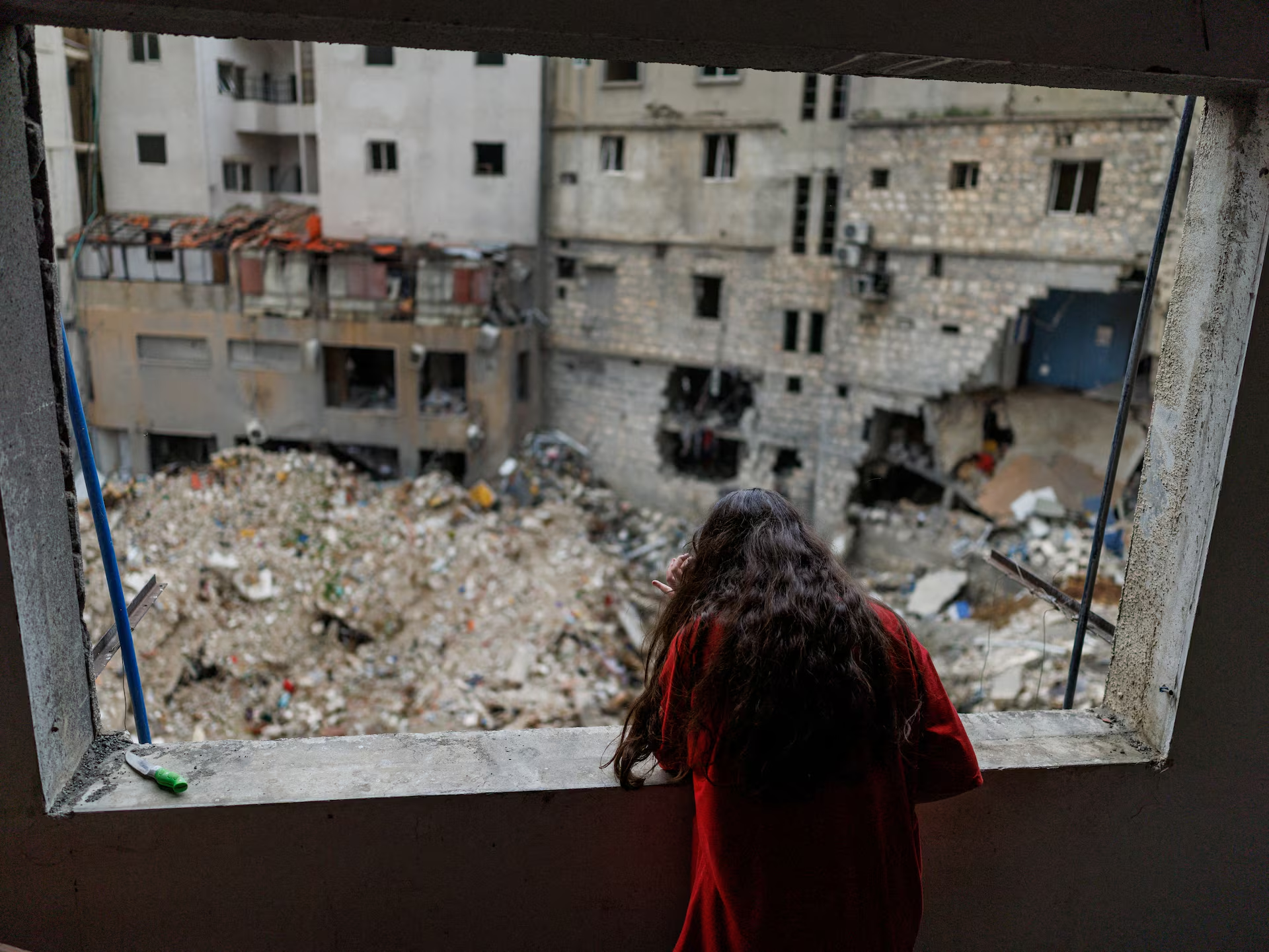
Alaa Dahnoun, 12, who said she survived an Israeli strike that forced her to flee with her parents to Beirut, looks out through her apartment’s damaged window after returning home in Nabatieh, Lebanon, April 18. reuters.com
Lebanon
As over one million displaced Lebanese families return to their homes, they are arriving to ‘unlivable’ rubble, said one man who lived in Nabatieh, a town in southern Lebanon that borders occupied Palestine and is in the “buffer zone” Israel has used to continue their colonization into Lebanon under the guise of fighting Hezbollah.
Since March 2, 2026, Israeli forces have been attacking Lebanese suburbs in Beirut, displacing millions, and destroying civilian infrastructure. Israel has called for evacuation south of the Litani River to the Zahrani River–15 percent of Lebanon’s territory. The IOF has threatened that anyone who remains in the zone “may endanger their lives due to Israeli military activity”.
On April 8, as the United States and Iran agreed on a ceasefire—one that includes Lebanon—Israel unleashed its largest bombing campaign against Lebanon since 1980. In just ten minutes, Israel struck more than 150 locations across southern Lebanon, mostly consisting of densely populated residential and commercial areas killing at least 303 people, wounding 1,150 others, and leaving hundreds trapped under rubble. This attack was justified by Israeli Defense Minister Israel Katz as ‘a surprise strike on hundreds of Hezbollah terrorists at command centers across Lebanon.’ When people displaced by these attacks tried to return home and assess the damage, they were warned by the Lebanese army that Israeli forces still occupied those regions and they could be ‘exposing themselves to the ongoing Israeli attacks.’
As Israeli forces bomb and occupy territory in Lebanon, they have now also implemented a “Yellow Line”—an imposed border 6 miles into Lebanon, that Israel claims is for the safety of northern Israel. The tactic of implementing a barrier was used in Gaza in October, and is used in zones where Israeli forces can fire upon anyone who approaches,—justifying it as ‘immediate terrorist threats’— and to demolish any buildings or infrastructure in the area. The Israeli Defense Minister, Israel Katz, has ordered the army to “demolish” Lebanese villages on the border, based on demolition methods used in Gazan cities like Beit Hanoun and Rafah. Netanyahu has ordered the IOF to further expand the ‘security buffer zone’ and to use the “Gaza model” of occupation as a template for southern Lebanon. Israel’s use of ‘Gaza-tested’ methods has lead many to call this the ‘Gazification’ of Lebanon.
Israeli strikes have targeted multiple key bridges that connect southern Lebanon to the rest of the country, cutting off vital routes for food, supplies, and necessities. The IOF has justified these blatant attacks to destabilize and disconnect southern Lebanon, with claims that the bridges were being used for “terrorist activity”.
Continuing a standing Israeli precedent of targeting first responders, Israel has killed over 100 vital health workers and injured 233. On April 15, Israeli airstrikes triple-tapped three ambulances as they were recovering bodies from another Israeli attack in Nabatieh. A paramedics station was also attacked, adding to the multiple cases of health workers being explicitly targeted. Israel claims that these places are being used by Hezbollah, but fails to provide evidence for these claims.
After the first agreed cease-fire, Lebanese families began returning to their homes to assess damages and “read prayers for the martyrs”, when Israel released its largest attack in decades. This attack added hundreds to the growing death toll, including a two year old girl who “was born in war and died in war”. As of April 28, the death toll in Lebanon is 2,509—at least 168 children and 254 women—7,658 fighting injuries, and unaccounted for people buried in rubble. 12 Israeli soldier have died.
Displaced families are arriving to find their homes either destroyed, too damaged to live in, or labeled by the IOF as “terrorist infrastructure” which allows them to bulldoze entire villages. Many are skeptical of how long the ceasefire will last; not only have Israeli attacks have not stopped, but Israel has also continued to demolish homes in southern Lebanon and still occupies a large portion of land from the border to the Litani river.
On April 22, seven days into the ceasefire, Israeli strikes targeted journalists reporting on at town destroyed by Israeli attacks, they survived the initial strike and fled to a nearby house which Israel then bombed as well. As aid was coming to help those injured in the strike Israel “prevented the completion of the humanitarian mission by firing a sound grenade and live ammunition at the ambulance.” Israel justified these attacks by saying they crossed the “forward defense line” and that the journalists and paramedics posed imminent threats to the IOF’s safety.

A man stands on a balcony under a single bulb, in a neighborhood in Havana sitting largely in darkness during a nighttime blackout. time.com
Cuba
There has been lots of “will they, won’t they” talk this month from the US administration as well as Cuba’s in regard to an imminent military incursion of the sovereign nation. In a statement on April 9th, Cuban President Díaz-Canel vowed that he would not bow down to public pressure from the US to resign. “In Cuba, the people who are in leadership positions are not elected by the US government,” he said. The illegal energy blockade on Cuba continues, forcing the country to import entirely from Russia, which only covers about a third of needs. But Díaz-Canel confirms that they are “not passive” and “will endure, but this situation is difficult.” When asked if Cuba was “on the brink of collapse”, Díaz-Canel says there is no collapse imminent. “That narrative appears whenever tensions rise. What country could endure decades of blockade and pressure and still function? We have not collapsed. We have universal healthcare, free education, and strong social programs. Yes, conditions are difficult, but the country remains organized and functioning.” He also said that despite claims from Secretary of State Marco Rubio, there is no current dialogue or negotiation taking place to removing the blockade, showing the US’s demands toward Cuba for “political prisoners released, multi-party elections, independent unions, and a free press” were made only for the US media and its viewers, not in good faith for the Cuban people and their leadership.
President Díaz-Canel further compared the threatened military incursion to the current war in Iran being carried out by the US and Israel, and the US kidnapping of President Nicolás Maduro from Venezuela, proving, to Díaz-Canel that targeting an individual or individuals leading a country does very little to uproot movements of sovereignty. “Sometimes they try to personalize the leadership of the Cuban revolution with a single person… but the thing is, we have a collegiate leadership, and we have a unity, cohesion, ideological unity. Therefore, removing one person within the structures of the institutions of the revolution will not solve any problem. Quite the contrary, there will be hundreds of people who are in a position to take that responsibility and collectively make decisions.”
President Trump on April 13 had more threats for Cuba, once again stating in a press briefing that “we may stop by Cuba after this” referring to his regime change war in Iran with Israel, and that he expects “to have the honor of taking Cuba.”
Cuba celebrated its 65th anniversary of the declaration of the Cuban Revolution as socialist on April 16, with President Díaz-Canel speaking to a crowd of thousands. “The moment is extremely challenging and calls upon us once again, as on April 16, 1961, to be ready to confront serious threats, including military aggression. We do not want it, but it is our duty to prepare to avoid it and, if it becomes inevitable, to defeat it.”
On April 17, Mexico, Spain, and Brazil collectively pledged more financial aid to Cuba, and expressed concern about the dire humanitarian crisis going on there. They also called for respect of Cuba’s sovereignty as a nation, while avoiding calling out the US’s involvement directly.
Engineers in Cuba made a breakthrough in heavy crude oil refinement and are now able to produce fuel oil and diesel from domestic sources for the first time. This is not only a good step towards energy independence in Cuba, but it also speaks to a weakness in western sanctions. If Cuba can refine its own crude oil, what’s stopping other Latin nations with large sources of crude oil and similar problems refining it (like Venezuela) from doing the same? Energy sanctions as a war tactic loses a bit of their bite.
A US war powers resolution put up on April 28 would have required the President to remove the illegal energy blockade, as well as any future military incursions, into Cuba unless approved by Congress. Republicans were able to get it dismissed, saying it was “out of order” because “the US is not engaged in outright hostilities with Cuba.” This dismissal succeeded with a 51-47 vote.

Venezuelans march across the country demanding an end to sanctions and defending national sovereignty. telesurenglish.net
Venezuela
On April 1, Venezuelan Acting President Delcy Rodríguez was removed from the Office of Foreign Assets Control’s “Specially Designated Nationals” list. The Trump administration first put Rodríguez on the list in 2018, along with First Lady and Deputy Cilia Flores, then-Defense Minister Vladimir Padrino López, and then-Communications Minister Jorge Rodríguez, claiming that they enabled the “destruction of democracy.” The US freezes any US-based assets of those on the list and bans them from any sort of economic relationship with US entities. Rodríguez stated that she believes the removal of her sanctions will lead to the lifting of all sanctions against Venezuela.
Acting President Rodríguez signed agreements with Chevron that granted its joint venture Petropiar access to the Orinoco Oil Belt. The agreements also increased Chevron’s stake in Petroindependencia, a mixed venture with Venezuela’s state oil company PDVSA. Similarly, Shell signed a contract with Venezuela’s government, expanding its presence in Venezuela and granting the company access to the Carito and Pirital oilfields in eastern Monagas state, as well as the 7.3 trillion cubic feet of the Loran field.
On April 17th, Acting President Rodríguez announced a diplomatic win for Venezuela: the recovery of Venezuela’s frozen assets in the International Monetary Fund (IMF), which paused their dealings with Venezuela in 2019. The recovery of these frozen assets allows Venezuela to improve basic services and social programs and prioritize rehabilitating essential infrastructure such as the national electricity system.
Thousands of Venezuelan citizens have been mobilizing in an anti-sanctions pilgrimage, demanding an end to the devastating international sanctions, primarily imposed by the United States and its allies. Called for by Acting President Rodríguez, the pilgrimage began in Zulia and is planning on convening in Caracas on May 1, on International Worker’s Day. A variety of forces, including “religious groups, business leaders, grassroots organizations, and opposition lawmakers” have participated in the pilgrimage, uniting around the demand to lift sanctions.
The death toll from illegal US military strikes on boats in the Caribbean Sea and Eastern Pacific has risen to 185 after strikes in the Caribbean Sea murdered three people on April 19th. The U.S. alleged that the boat was “engaged in narco-trafficking operations” while providing no evidence. Despite Trump’s focus on Venezuela, the majority of strikes in the past few months have targeted boats in the eastern Pacific. U.S. strikes killed a total of five people in boats in the eastern Pacific Ocean on April 24 and April 26.
In late April, the U.S. Treasury Department agreed to allow President Maduro and First Lady Flores’s attorneys to receive payment from the Government of Venezuela without violating US sanctions laws. Due to US sanctions, anyone seeking payment from the Maduros or the Venezuelan government needs a license from the Treasury Department’s Office of Foreign Assets Control (OFAC). In what prosecutors claimed was an “administrative error,” OFAC revoked a previously granted license allowing the Maduros’ attorneys to receive payment from the Venezuelan government, asserting that the Maduros could pay their legal fees with their personal funds.