
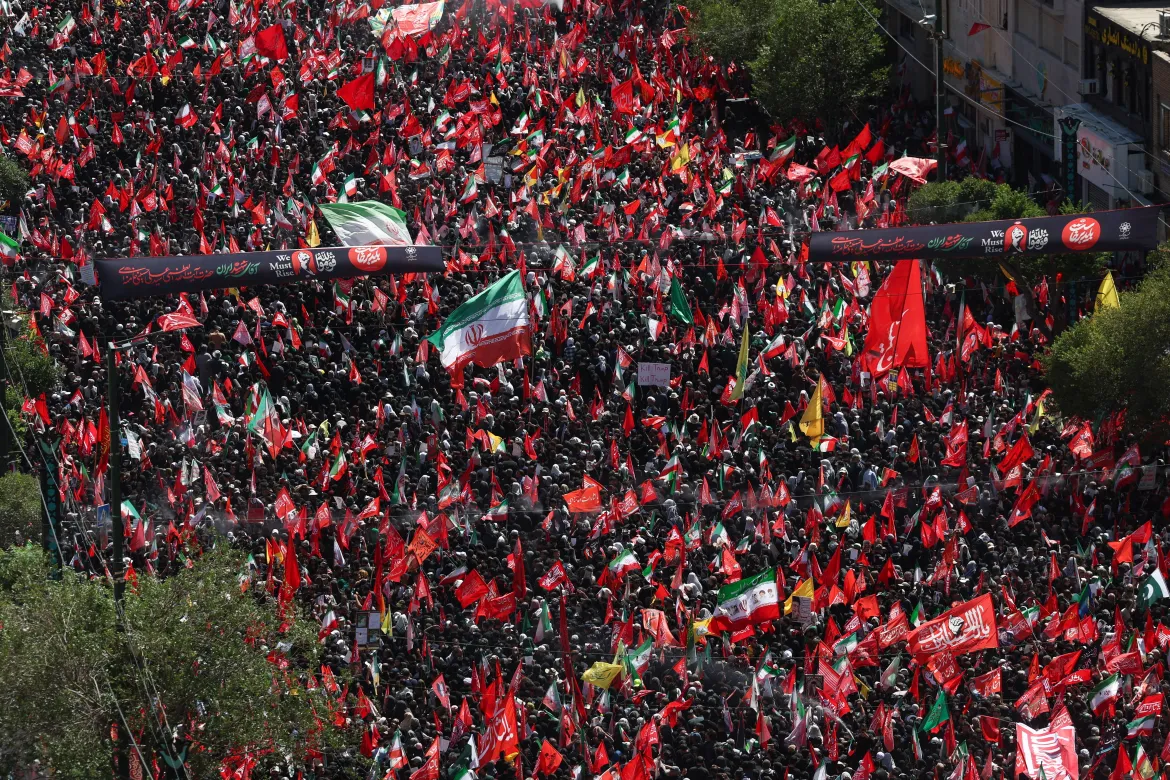
Mourners attend the burial ceremony for Iran’s late Supreme Leader Ali Khamenei in Mashhad. (Majid Asgaripour/WANA via Reuters)
DAWA Updates
DAWA’s Most Recent Events Include
- 7/2 – Fundraising Fest: At the beginning of July, DAWA held a fundraising fest at City of Cuernavaca Park in Denver. At the event, DAWA raised funds to send members to the annual AWAN (Anti-War Action Network) Conference. The fest featured a number of local art vendors, music from protest marching band Notes of Dissent, Mediterranean food, an anti-war trivia game, dart throwing, and more!
- 7/4 – 4th of July Rally Against Trump: On the 4th, DAWA marched with allied Denver Coalition Against Trump (DENCAT) organizations, demanding an end to the racist and reactionary Trump agenda. DENCAT organizations spoke against imperialist wars, ICE terror, and demanded that Colorado governor Jared Polis actually fight for the demands of the people he claims to support.
- 7/11 – 7/12 – AWAN Conference: On the weekend of July 11th and 12th, DAWA sent twelve members to the annual Anti-War Action Network (AWAN) Conference, held this year in Chicago. DAWA met with activists from around the country, sharing strategies and experiences related to the anti-war movement. DAWA members attended workshops on campaign building, solidarity with Latin America and Africa, coalition work, graphic design, fundraising, marshaling, media relations, and more. DAWA listened to panels about wins and tactics in campaigns related to fighting war profiteers and pushing for divestment. DAWA’s own Hatem Teirelbar represented the group on the Organizing Against War Profiteers panel, sharing the strategies that underpinned DAWA’s successful fight to kick Palantir’s headquarters out of Denver.
- 7/25 – Anti-War Family Picnic: This past Saturday, DAWA held a family picnic next to Sloan’s Lake near Edgewater. Kids enjoyed having their faces painted by artistic DAWA members and decorating kites in solidarity with children in Palestine. Attendees of all ages painted the flags of Palestine, Cuba, Iran, the DR Congo, and more on fabric rectangles. Attendees also helped themselves to food and dessert supplied by DAWA. At the center of the picnic area was a large tent containing exhibits honoring many of the children who have been martyred in Palestine, as well as tips from UNICEF on how to have difficult conversations with kids on topics related to conflict and war.
Upcoming Events
- 8/1 – Stop Trump’s Illegal War on Iran: Join DAWA at Colorado State Capitol this Saturday at 5 pm to protest Trump’s escalation of the war on Iran! The Trump administration has made it clear over the past few weeks that its signing of the Memorandum of Understanding with Iran was not a genuine attempt to promote peace, but a play for time. Trump won’t hand Iran a peace agreement on its own—it must be won by the organized masses.

Three boys play in the shallow waters of the Strait of Hormuz, as a plume of smoke rises from an explosion in the background, off Bandar Abbas, Iran, Monday, July 13, 2026. Razieh Poudat – ISNA
Iran
After claims that Iran struck a commercial vessel on June 26th, the US carried out two consecutive days of strikes on Iranian targets. On June 28th, Iran’s Minister of Foreign Affairs, Abbas Araghchi, said that the Strait would be “under total Iranian control for the next 30 days,” as per the Memorandum of Understanding agreed to by both the US and Iran on June 17th. He advised vessels to work with the IRGC for safe passage. This memorandum, strained from the start by the US’s violation of multiple points—ceasefire agreements, Iran’s control over the Strait, the unfreezing of foreign Iranian assets, and more—was declared null by Trump on July 8th amid a slurry of insults towards the Iranian people. Facing the US’s aggression, Iran has been maintaining their “tit for tat” stance, only striking US outposts in the region when provoked.
Bypassing Congress, Trump resumed the war and bombed Iran on July 7th, following his word that he would not initiate new strikes during Iran’s seven-day funeral procession for the late Ali Khamenei (which began July 3rd). The escalations came after Israeli intelligence supposedly found “Iranian plots to assassinate Trump,” leading to Trump’s aggressive strikes to destroy Iranian infrastructure—water desalination plants, bridges, etc.—and claiming that he would “completely decimate and destroy” Iran. On July 15th, a children’s cancer treatment hospital had to be evacuated due to US bombs being dropped nearby.
The attacks were paused after 14 consecutive days of bombings from the US. This pause is being used by the US to restock munitions and missiles in the region, as they have been dwindling since the war started on February 28th. US officials have made it clear any notions of diplomatic resolutions are far away.

Palestinian patients and wounded people gather outside Nasser Hospital in Khan Younis, Gaza on July 5, 2026, to demand medical treatment abroad amid Israeli restrictions. Photo by Abed Rahim Khatib/Anadolu via Getty Images.
Gaza
Despite the “ceasefire agreement” that took effect in October, the IOF has continued its occupation of Gaza this month with air and drone strikes, the leveling of encampments, bulldozing of personal property, and the assassination of civilians in the streets. Israeli forces now control at least 67% of Gaza.
The Hamas government has engaged in talks, with plans for the National Committee for the Administration of Gaza (NCAG) to take over administration of Gaza under Trump’s Board of Peace plan. The Board has made the NCAG’s entry contingent on Palestinian acceptance of a 15-point “roadmap” that appears aimed at disarming the Palestinian resistance and the abandonment of Palestine’s national liberation struggle.
Dr. Hussam Abu Safiya is still detained by Israeli forces, without charge or trial, and his health is rapidly deteriorating. He has lost over 45 kilos and is suffering from a serious eye injury sustained during his capture. Many parties are publicly calling for his release, including a UN agency and several US senators. A plea was submitted to Israel’s Supreme Court regarding Dr. Safiya being released and receiving proper medical treatment. It was ultimately rejected by the state, which evasively stated that the doctor has been examined several times.
Israel plans to herd Palestinians into controlled “shelters”, starting in couple of weeks. The plan calls for a mass-surveilled “community” where Palestinians will be forced to give up whatever freedom of movement they have left in exchange for aid. It will also benefit the IOF’s expansion plans as these encampments will be outside of Hamas governance.
Israeli restrictions on crossings into Gaza continue to suffocate the territory. Under the terms of the ceasefire, at least 50 trucks of fuel are supposed to enter the Strip every day. Only 14.9% of this amount has been allowed into the territory.
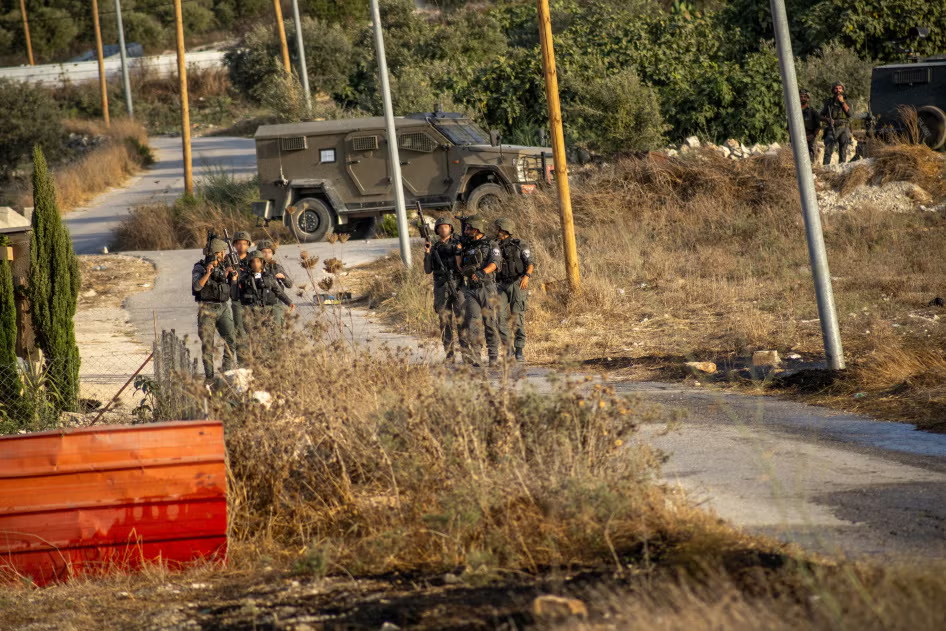
Israeli forces fire tear gas at Palestinians and journalists covering military operations and settler activity in the nearby village of Tal, in the West Bank, July 25, 2026. © 2026 Roman Levin/Sipa via AP Photo
West Bank
In July, Israeli settler attacks in the occupied West Bank increased frequency from June, itself already at an all-time high. From July 1st to 24th, Israelis murdered 13 Palestinians, including three children.
On July 17th, Israeli soldiers invaded Nablus, broke into and vandalized three homes, and abducted three residents. Colonizers destroyed electricity poles near the town of Beita. Near Jurish, colonizers assaulted Palestinian residents and international activists while Israeli soldiers fired stun grenades.
Also on July 17th, in occupied Jerusalem, Israeli police shot one young man and abducted another. South of Bethlehem, colonizers destroyed the drinking water network, stealing water tanks and destroying water lines. Settler attacks have escalated south and east of Bethlehem, including breaking into homes, attacking residents, and attempting to run over Palestinians.
On July 18th, northwest of Ramallah, Israeli soldiers invaded the village of Kafr Ein, leading to protests before soldiers fired gas bombs and concussion grenades. The same day, Israeli occupation authorities issued an order confiscating over four acres of Palestinian land in Doura al-Qare.
Against this backdrop of escalated settler violence, over 50 Israeli settlers stormed the village of Tal near Nablus, attacked Palestinian homes, and fired ammunition at Palestinians. Settlers fired on Palestinians, until a Palestinian disarmed a settler and shot and killed two settlers in self-defense. Settlers and soldiers then murdered the man and three of his unarmed family members.
The community of Tal held funerals for the martyrs in the middle of the night because Israel prohibits funerals during the day. Benjamin Netanyahu and Israel Katz ordered a “wide-scale military operation” across the West Bank following the deaths. Israelis have killed at least 87 Palestinians in the West Bank in 2026. The death of the aforementioned Israeli assailants may be used as justification for even more accelerated violence. Don’t look away.

Israeli-caused destruction in the southern Lebanese village of Al-Mansouri. Al Mansouri, Lebanon. July 16, 2026. Photo by Katrine Dige Houmøller.
Lebanon
Despite the inclusion of Lebanon in the US and Iran’s mostly defunct MoU and the more recent signing of agreements between Lebanon and Israel brokered by the US, Israeli strikes continue to kill in southern Lebanon. On July 23rd two medics were injured in a strike on an ambulance; villages across southern Lebanon have been systematically demolished to make way for Israeli “security zones“, including the village of Majdal Zoun which was occupied by Israeli forces in June and is now used to attack the neighboring village of Al-Mansouri on a daily basis. Over 4,000 people have been killed in Lebanon since hostilities reignited on March 2nd, including hundreds of children.
From March through June, Israeli soldiers displaced over 1.2 million people, forcing entire villages to leave their lives and livelihoods. Israel maintains its occupation of many parts of Lebanon, controlling nearly one fifth of the country’s territory, with hundreds of thousands of people still displaced. A US brokered agreement falls drastically short of justice, extracting few promises from Israel and has been criticized for putting primary obligations on the shoulders of the Lebanese government. Furthermore, Israel continually violates this agreement, meaning those able to return see their homes demolished by the Israeli military.
Following the signing of trilateral agreements in June, Lebanon’s president Joseph Aoun was the first Lebanese president in nearly two decades to be invited to the White House, marking a new era in the relationship between Washington and Beirut. Both President Trump and President Aoun have deemed Hezbollah as the primary problem in Lebanon. Meanwhile, Hezbollah has criticized the Lebanese government for engaging in talks with Israel and for the signing of agreements that favor Israel and aim to disarm Hezbollah without a clear commitment by Israel to fully withdraw from occupied Lebanese territory.
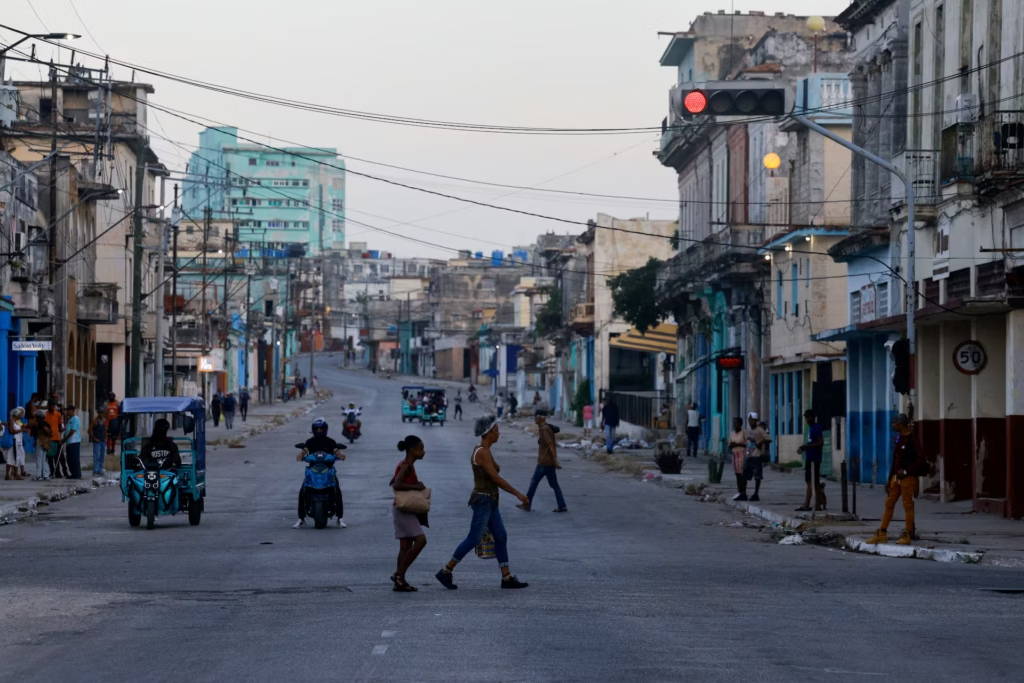
People cross a street as Cuba’s national power grid is restored following its collapse, which marked the third major outage in nine days, in Havana, Cuba, July 15, 2026. REUTERS/Norlys Perez
Cuba
A “silent Gaza”. This is how a Cuban described the ongoing US blockade to US Democratic Party representative Mark Pocan during his visit to Cuba this month. Pocan agreed with he metaphor, emphasizing that “[Cubans] can’t go to work, they can’t preserve their food, they can’t access medical supplies.” This statement was made hours after the US State Department announced additional sanctions against Cuban entities on July 13th, including the Ministry of Tourism and multiple energy importers. The announcement of these sanctions came within an eight-day period where the island nation saw three nationwide blackouts.
The Cuban government appealed to the international community by calling for a vote during the UN General Assembly’s session on July 7th. This vote aimed to initiate a debate over the current US economic blockade on the grounds of the humanitarian crisis created by it. Despite the State Department attempting to sway the vote by demanding that the UN member states object, the assembly voted overwhelmingly with Cuba, with 136 out of 175 members in favor. This result follows a strong trend where the UN has voted 31 consecutive times to condemn US sanctions on Cuba.
Along with additional sanctions, the Trump administration released a 100-page report on July 21st, titled “Cuba: The Capital of 21st Century Communism”. This report accuses Cuban intelligence of infiltrating the US government and attempting to link groups like the Democratic Socialists of America (DSA) to Cuban intelligence. Cuba’s Foreign Ministry called the report “a mediocre propaganda pamphlet” meant to “manufacture consensus for eventual military aggression”. This sentiment was echoed during Cuban President Díaz-Canel’s speech on National Rebellion Day (July 26th), calling the Trump administration’s policies “political genocide” and affirming that Cuba is not a threat to the United States or any country on the Earth.
Big Tech in Your Backyard

Aurex: Golden Dome in the Front Range?
Aurex is a new defense corporation headquartered in Huntsville, Alabama. Aurex’s portfolio includes projects ranging from hypersonic systems to missile defense, space domain awareness, and commercial space. Aurex formed when Special Aerospace Services, a Godspeed Capital Management LP-backed platform, rebranded in 2025 to the name Aurex. That same year, the company opened manufacturing facilities in Huntsville and the Denver area, totaling 65,000 square feet of space between the locations. Aurex describes the new facilities as being “designed to accelerate classified programs, rapid prototyping, precision manufacturing, systems integration and scaled production across missile defense, space, communications and counter-UAS [Unmanned Aircraft Systems] missions”. The Denver-area “Flight Factory” is located in Arvada at 5627 Kendall Court.
Aurex’s marketing pushes the company as a key contractor for Trump’s “Golden Dome” project, whose name is inspired by the less-than-impenetrable Israeli “Iron Dome”. If built, Golden Dome would combine surface-to-air missile interceptors, radar, space-based missile tracking and communications satellites, and possibly even satellites armed with missile interceptors (the first time such weapons would ever have been placed in space). Aurex aims to support Golden Dome by providing digital modeling, integration, test execution, and prototype builds for various technologies involved. According to CEO Warren Kohm, “Golden Dome reflects a shift toward integrated defense architectures” that combine a large array of technologies “into a unified operational capability.” He pitches Aurex as being “built for this environment: focused on speed, integration, and the ability to operate effectively under real mission conditions.”
Aurex also does extensive work on hypersonic weapons, including the delivery vehicles for nuclear warheads. The company performs physics-based modeling and simulation for these systems, as well as work on GNC (guidence, navigation, and control) systems for hypersonic weapons. Aurex even develops its own AI, named GHOST-AI, designed for the optimization of hypersonic systems.

Artist’s rendition of a Collaborative Combat Aircraft (CCA) drone.
Longmont and Centennial: General Atomics
“Colorado is home to the nation’s second largest space economy, and we are excited to continue to expand our development, production and mission capabilities in the region to meet the growing needs of the military, intelligence community, civil and commercial satellite communities”
—General Atomics announcing the opening of their facility in Centennial, CO.
It is the norm for aerospace companies to be eager participants in war profiteering, and General Atomics is no exception. Though the company presents itself as primarily focused on spaceflight, they are also the designer and manufacturer of some of the US military’s most infamous drones from the past few decades. These include the MQ-9 Predator and the MQ-9 Reaper, which was used to to provide intel to Israel during their genocide in Gaza.
More recently, General Atomics was picked by the Air Force to build the military’s first “Collaborative Combat Aircraft” (CCA) alongside Anduril. CCA drones seek to do for drone warfare what Maven did for the Pentagon’s “target kill chain” in that they are autonomous, AI-powered killers. These drones are meant to fly in formation with a single pilot who acts as the formation’s lead, but otherwise are fully piloted by Shield AI.

Wins
At the 2nd annual AWAN conference, DAWA members learned about movement wins from across the country. For example, in 2025, Palestine Solidarity Grand Rapids organized a 75-mile march for Palestine raising $22,000. Twenty-nine protestors marched 75 miles over the course of five days, starting in Grand Rapids and ending in Lansing. Donations came from t-shirt sales, businesses, employer-matches, and individuals, and went to HEAL Palestine, Playgrounds for Palestine, and The Gaza Infant Nutrition Alliance.
An organizer described NOSHIP’s (New Orleans Stop Helping Israel’s Ports) victory in removing Chevron as a title sponsor of the French Quarter Fest for 2026 and as a sponsor altogether for future years. NOSHIP researched similar campaigns’ successes, selected a target that resonated with the people of New Orleans, tapping into the community’s existing frustration with Chevron, and built coalition by organizing with musicians and environmental groups. NOSHIP’s organizing broke a 13-year run of Chevron sponsoring the French Quarter Fest.
Additionally, we learned about Anti-War Committee Chicago’s divestment campaign targeting the Illinois State Board of Investment (ISBI), which manages investments for state employees’ retirement funds. When ISBI did not post their annual report, which they had previously published to their website every year, Anti-War Committee Chicago submitted a Freedom of Information Act (FOIA) request. The FOIA request revealed that ISBI divested $33 million dollars from Israel.
Late June saw momentous wins for the BDS movement, with the United Auto Workers union voting to divest from Israel and the Presbyterian Church (USA) voting to recognize the genocide in Gaza and divest from Palantir Technologies and General Electric Aerospace.
Melat Kiros, a pro-Palestine, democratic socialist, won the primary election in the first congressional district. Kiros defeated Diana DeGette, ending DeGette’s almost thirty year run of representing Denver in Congress. Kiros’s platform emphasizes ending US aid to Israel.
Support and Solidarity

Help those facing ICE oppression, support the Sanctuary 4 All Legal & Mutual Aid Fund!

Help Immigrant Rights Protesters Facing State Repression Get Legal Support!

Support Emma Landis After Aurora ICE Shooting
