
Denver Anti-War Action Updates
Denver Anti-War Action (DAWA) is a local community organization that opposes U.S. imperialism and the military-industrial complex worldwide. DAWA’s recent activity has largely focused on our campaign targeting Palantir, a software company with customers including the IOF (Israeli Occupation Forces) and ICE (Immigration and Customs Enforcement). Palantir is in the process of moving their headquarters out of the Tabor Center in downtown Denver to the Cherry Creek neighborhood, and DAWA is now working to build a broad coalition to expel Palantir from this new location. Additionally, as a co-founder of Denver Coalition Against Trump (DENCAT), a coalition of a diverse array of local organizations, DAWA remains committed to fighting Trump’s racist and reactionary agenda.
DAWA’s most recent events include:
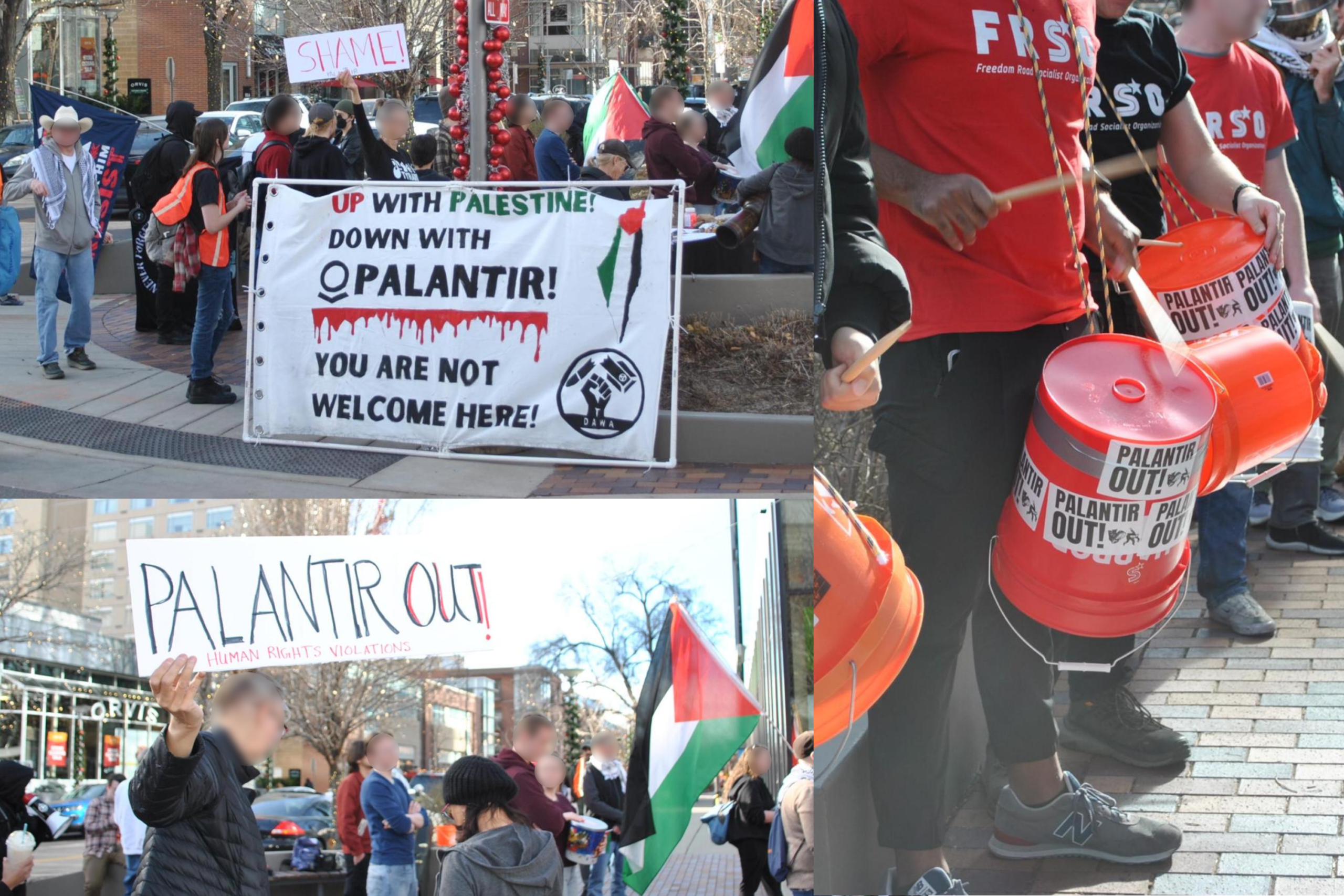
- Palantir Out – Noise Disruption (Sunday, 12/21/2025)
- DAWA and allies drew crowds equipped with drums, pots and pans and instruments to a noise rally demanding Palantir out of Cherry Creek! Sign the petition here!
- International Human Rights Day Rally (Sunday, 12/7/2025)
- DAWA mobilized against Palantir’s flagrant human rights violations outside the Tabor Center in response to the national Anti-War Action Network’s call for a week of action for International Human Rights Day.
- Anti-Palantir Banner Make and Banner Drop (Monday, 12/1/2025 and Thursday 12/11/2025)
- DAWA and its allies collaborated to create a stunning banner for use at future events. It made its first appearance draped over a balcony facing the future location of Palantir’s headquarters in the Cherry Creek Financial House.
- DENCAT rally against deportations at Colorado State Capitol (Saturday, 11/22/2025)
- DENCAT launched its campaign against Trump’s racist and reactionary agenda by marching to Jared Polis’s mansion to demand he stand for the people of Colorado.
- Defend Venezuela Rally to demand US hands off (Friday, 11/21/2025)
- DAWA members and Freedom Road Socialist Organization members rallied outside the Capitol to demand an end to the U.S. militarism in Venezuela.
DAWA will be hosting/cohosting these upcoming events:
Big Tech in Your Backyard: Palantir
Palantir, a tech firm that develops software for big data analytics, has recently become infamous for the deep ties of its founders to the Trump administration as well as its involvement in Israel’s genocide in Gaza and ICE’s deportation campaigns. Formerly headquartered in the Bay Area, the company was compelled to leave in large part by local anti-war activists. It then moved right here to Denver, a city it perceived to be more friendly to its style of business. Though Palantir has had highly suspect connections for years (it has been an ICE contractor since 2011, for instance), the corporation has gained mainstream notoriety over the past year among both the politically conscious and investors.
In our last newsletter we covered Palantir’s ties to the Trump administration via its cofounder, Peter Thiel, and current CEO, Alex Karp. While this closeness between the company and the current administration has become a source of controversy, it has also been a boon for Palantir’s business, leading to a number of defense contracts that ensure it can turn a profit even in an unstable economy. Just recently, Palantir signed a $448 million contract with the United States Navy in designing a “Shipbuilding Operating System (Ship OS),” which seeks to use AI to automate much of the project management aspect of shipbuilding jobs. In addition, they have secured a contract with US Citizenship and Immigration Services, an outspoken collaborator with ICE, further deepening their connections to and support of ICE’s reign of terror.
Outside of government contracts, Palantir has sought to expand its reach by partnering with other companies and sectors. This month alone they have:
- Announced a strategic partnership with Northslope, recognizing them as first member of Palantir’s new “Vanguard: Elite” partner network.
- Unveiled “Chain Reaction,” an operating system for energy infrastructure which aims to increase efficiency of existing power plants, and the construction of new ones, to meet power demands of new AI data centers. The software is a partnership with NVIDIA and Centerpoint Energy. NVIDIA founder and CEO Jensen Huang stated recently that Israel “has become NVIDIA’s second home” as they have become the first international tech company to own land in Israel (aka, Occupied Palestine.)
- Become a subcontractor for a foreign funding portal site for the Department of Education through a company called Monkton.
While Palantir seeks to exert their influence across both public and private sectors, CEO Alex Karp remains in the limelight of controversy for his constant dehumanizing and sociopathic remarks:
- At the NYT’s DealBook summit (Dec 3), Karp stated that legalizing war crimes would provide a good business opportunity to Palantir. This mirrors his statement to shareholders early this year that “the rise of the West” was achieved through violence.
- Defending his work with ICE, Alex Karp has also stated that he would use his influence “to make sure this country stays skeptical on migration.”
- There has also been the company’s continued collaboration with and support of Israel’s terror campaigns, with a recent book linking them to 2024’s pager bombing in Lebanon.
Palestine Updates
Gaza
December 30 marked 816 days of ongoing genocide in Gaza. On October 10th, Israel and the US implemented a “ceasefire” agreement with Hamas, which Israel has since broken, violating its terms over 875 times and killing at least 411 Palestinians. Journalists on the ground continue to document ongoing genocidal atrocities by the IOF, showing the world these daily violations as they happen.
Since the “ceasefire,” Israel has added 13 new military outposts to its already heavily militarized presence in Gaza. Showing no signs of intent to end its siege, the IOF maintains governance of 58% of Gaza and continues to push further into Palestinian sovereign territory. The occupation uses the mostly invisible boundary of “the yellow line” to mark “the yellow zone,” where they regularly execute Gazans who unknowingly cross into the prohibited area. In one of dozens of such murders, Israeli forces shot to death 3-year-old Ahed al-Bayouk for crossing into their designated kill zone – subsequently labeling the child a “terrorist” threat who required “elimination.”
According to the U.N., Israel has let in only 20% of the mandated number of aid trucks since the “ceasefire” began. Many essential items are denied entry, including medical supplies, shelter, nutritious food, and machinery necessary to dig bodies from the rubble and to rebuild. While it deliberately starves and freezes to death the Gazan people by refusing these items, Israel smuggles narcotics into the besieged area as a deliberately deployed “soft weapon” to gain psychological control and and erode the social foundations of its victims.
Here is a snapshot of the hundreds of Israel’s “ceasefire” violations over the last 81 days: The IOF shot 16-year-old Zaher Nasser Shamia, blocked first responders from reaching him, and ran a military bulldozer over his body. During their bombing of a displacement camp and nearby hospital, Israeli forces burned to death a Palestinian family in their tent, including a father and two children aged 8 and 10. In Al-Tuffah at a school-turned-shelter, the IOF slaughtered at least six Gazans in an airstrike on a wedding.
West Bank
As the genocide in Gaza continues, Palestinians in the West Bank are living under occupation in other ways. In the Jordan Valley, the IOF is in advanced stages of building a new fence that cuts Palestinians off from 11,000 acres of their land, including plans to completely encircle the shepherding community of Khirbet Yarza.
In Jenin and Tubas, over 95,000 Palestinians have been affected by expanded Israeli operations, including imposed curfews, restricted movement, and forced displacement as Israel seized entire residential buildings to be converted into military posts. Two Palestinian children were injured with live ammunition after being shot at by Israeli forces in Jenin refugee camp, and Save the Children has reported that the operations have forced it to halt education and child-protection work without any indications as to when these services will be able to resume.
An UNRWA (United Nations Relief and Works Agency for Palestine Refugees) compound in occupied East Jerusalem was raided by Israeli police, claiming entry for a “debt collection procedure.” Communications for the entire neighborhood of Sheikh Jarrah were cut off and the UN flag was replaced with an Israeli one. The raid has been condemned by UN officials, claiming it breaks international law and showcases Israel’s complete disregard for it’s obligations as a UN member state.
An average of 5 settler attacks a day have been documented by OCHA (UN’s Office for the Coordination of Humanitarian Affairs) in over 270 communities across the West Bank since the start of 2025. Each of these over 1,700 attacks resulted in casualties or property damage, including the vandalism of (mostly) olive trees and saplings. Attacks left more than 1,100 Palestinians injured, both by Israeli settlers and Israeli forces.
A global campaign to free prominent Palestinian leader Marwan Barghouti—known by many as Palestine’s Nelson Mandela—was launched by his family in December. Just days later, his son received a phone call from an Israeli number, claiming guards had broken Barghouti’s ribs and teeth, and cut off parts of his ear for entertainment. Concerns over his safety and the safety of all Palestinians held in Israeli prisons—nearly 10,000 people, at least 3,300 of which are being held without charge or trial—has been raised over and over again by both Palestinian and Israeli rights groups.
Venezuela Updates
Background
In 1998, following years of increasing poverty and economic stagnation under neoliberal administrations, the people of Venezuela elected Hugo Chávez as their next president. Chávez’s political movement would go on to lead a nationwide transformation known as the Bolivarian Revolution. His administration saw poverty in Venezuela reduced by more than a third, and extreme poverty cut by 57%. It kickstarted a housing program that has built over five million housing units for low-income Venezuelans to date, along with related social infrastructure like schools and green spaces. Thanks to the large-scale mobilization of working-class Venezuelans, his government survived a US-backed coup attempt in 2002 to remove Chávez from the presidency and replace him with the head of Venezuela’s largest business association.
However, in 2013, Venezuela entered an economic recession following a collapse in global oil prices. The majority of state revenue in Venezuela, the country with the world’s largest oil reserves, comes from oil exports. Oil prices began to rise in the following years, but Venezuela’s economy was prevented from recovery first by U.S. sanctions under Obama in 2015 that reduced the country’s access to credit, and then by a series of sanctions under Trump beginning in 2017 that decimated Venezuela’s oil production and starved the government of 99% of its revenue. Further sanctions in 2019 severely limited Venezuela’s access to international payments systems, wiping out most of the country’s food, medicine, and other essential imports. Despite a partial economic recovery over the past few years, the Venezuelan people are still struggling from the effects of sanctions.
Recent Updates
Though the U.S. government has long been hostile to the Bolivarian Revolution (under both Republican and Democratic administrations), the past few months have included unusually blatant attempts by the Trump administration to force regime change in Venezuela. In an attempt to remove Chávez’s successor, Nicolás Maduro, the U.S. has built up a military presence in the Caribbean over the past few months that is among the largest in the region’s history. The U.S. military has stationed over 15,000 troops and over a dozen ships in the region, including its largest aircraft carrier. Additionally, since early September, the Trump administration has carried out 31 unlawful strikes on small boats off the shores of Venezuela and Colombia, killing at least 107 people. On Nov. 29, Trump ordered the airspace over Venezuela closed, despite having no formal authority to do so. Regardless, non-Venezuelan airlines have suspended flights in and out of the country one by one.
Recent moves related to Venezuela’s vast oil sector indicate the primary reason the US government is interested in regime change in the country. On Dec. 2, a U.S. judge in Delaware approved the takeover of Venezuelan state-owned refiner CITGO by U.S. vulture fund Elliott Management. Officially marketed as a means to settle debts held by Venezuela, the Venezuelan government was completely excluded from the process. Furthermore, on Dec. 10, the U.S. Coast Guard and Navy seized an oil tanker leaving Venezuela’s Port of Jose. Trump announced that the U.S. intends to keep the seized oil, which could be worth up to $95 million.
The third week of December saw a string of incredibly dangerous escalations. On Monday, Dec. 15, Venezuela’s state oil company PDVSA was hit by a cyberattack originating from the U.S. that temporarily disrupted its operations. On Dec. 16, Trump designated Venezuela’s government a foreign terrorist organization and ordered a blockade of all sanctioned oil tankers from transporting oil to and from Venezuela. This blockade essentially constitutes an act of war. If enforced, it would cut off a huge portion of Venezuela’s national revenue and provoke a humanitarian and financial crisis in the country. In response, Venezuela has ordered its navy to escort oil tankers, setting the stage for a military confrontation with the U.S. U.S. forces significantly escalated the blockade on Saturday, Dec. 20, seizing a second oil tanker leaving Venezuela that was not even on the list of U.S.-sanctioned vessels.
It was revealed in late December that earlier in the month, the CIA carried out a drone strike on an undisclosed port facility on Venezuela’s coast. CNN reported on the strike Monday, and Trump claimed on the same day that there had been a major explosion at a port on Venezuela’s coast. Trump said that the dock was targeted because it was allegedly used by drug traffickers. Venezuela’s government has not confirmed the strike, but as the first openly admitted US strike on Venezuelan soil, it represents a further massive escalation in Trump’s campaign against the Venezuelan people.
In his address on election night last year, Trump told the people of this country — and the world — that he was going to “stop the wars,” not start them. It should go without saying that we cannot count on Trump to keep this promise, nor can we count on politicians on either side of the aisle. The only way that we can guarantee that Trump’s plans for war with Venezuela are halted is by building broad anti-war coalitions here at home. We must jam the gears of the war machine right here where they are turned. If you are looking for a way to fight U.S. aggression against Venezuela and elsewhere, consider joining Denver Anti-War Action. We are planning to mobilize in support of Venezuela in the very near future.
Wins
Local immigrant rights activist Jeanette Vizguerra was released from the GEO run facility in Aurora on December 22nd after nine months of detention following her arrest by ICE in March. Crowds have gathered at the facility every Monday since to demand freedom for her and others held there. At a hearing on December 19th, at which members of Vizguerra’s legal team were denied entry to the courtroom for over 40 minutes by guards with the GEO Group, a judge ruled that Vizguerra’s detention has been prolonged unconstitutionally and she has been released on an $5,000 bond.
Activists in Michigan have claimed a major divestment win as the State of Michigan Retirement System drops all investment in Israel Bonds (debt securities that act as loans to the state of Israel) including declining to reinvest in a $10 million bond that was set to expire in November. This is the first time in 30 years that Michigan’s pension system has been free of Israel Bonds.
Similarly in Minnesota, the State Board of Investment has released data confirming that it holds only one remaining Israel Bond after sales and non-renewals beginning in 2021, the most recent of which dates back to October 9th, 2025. After two years of protests organized by pro-Palestine activists and public pension holders, and despite SBI claims that investment policy hasn’t changed, organizers in Minnesota say this is just the beginning of their demands, and are calling on the Palestine solidarity movement to seize this moment to demand complete divestment from apartheid Israel.
Solidarity activists from the US have broken through Trump’s declared “no-fly zone,” landing in Caracas, Venezuela on December 9th. Hundred of organizers across the US were invited to attend the International Peoples’ Assembly for Sovereignty and Peace in Caracas; however, because of the no-fly zone, most flights to and from the country were cancelled. Despite this, many people were able to get into the country and some even say overcoming these obstacles has made them even more excited to participate.
Schools in Gaza have begun to reopen, including the Islamic University which has resumed in person learning for the first time in 2 years, despite more than 90% of the campus buildings being reduced to rubble. Over 165 schools, universities, and other educational institutes were completely destroyed by Israel and nearly 400 have been partially destroyed. This destruction of Palestinian educational systems was dubbed by UN experts as “scholasticide.” But gradually and partially, schools have been coming back to Gaza, with local and UN agencies working to set up temporary learning spaces for the over 700,000 students who have been out of school since October 2023.