
Denver Anti-War Action Updates
Denver Anti-War Action (DAWA) is a local community organization that opposes U.S. imperialism and the military-industrial complex worldwide. DAWA’s recent activity has largely focused on our campaign targeting Palantir, a software company with customers including the IOF (Israeli Occupation Forces) and ICE (Immigration and Customs Enforcement).
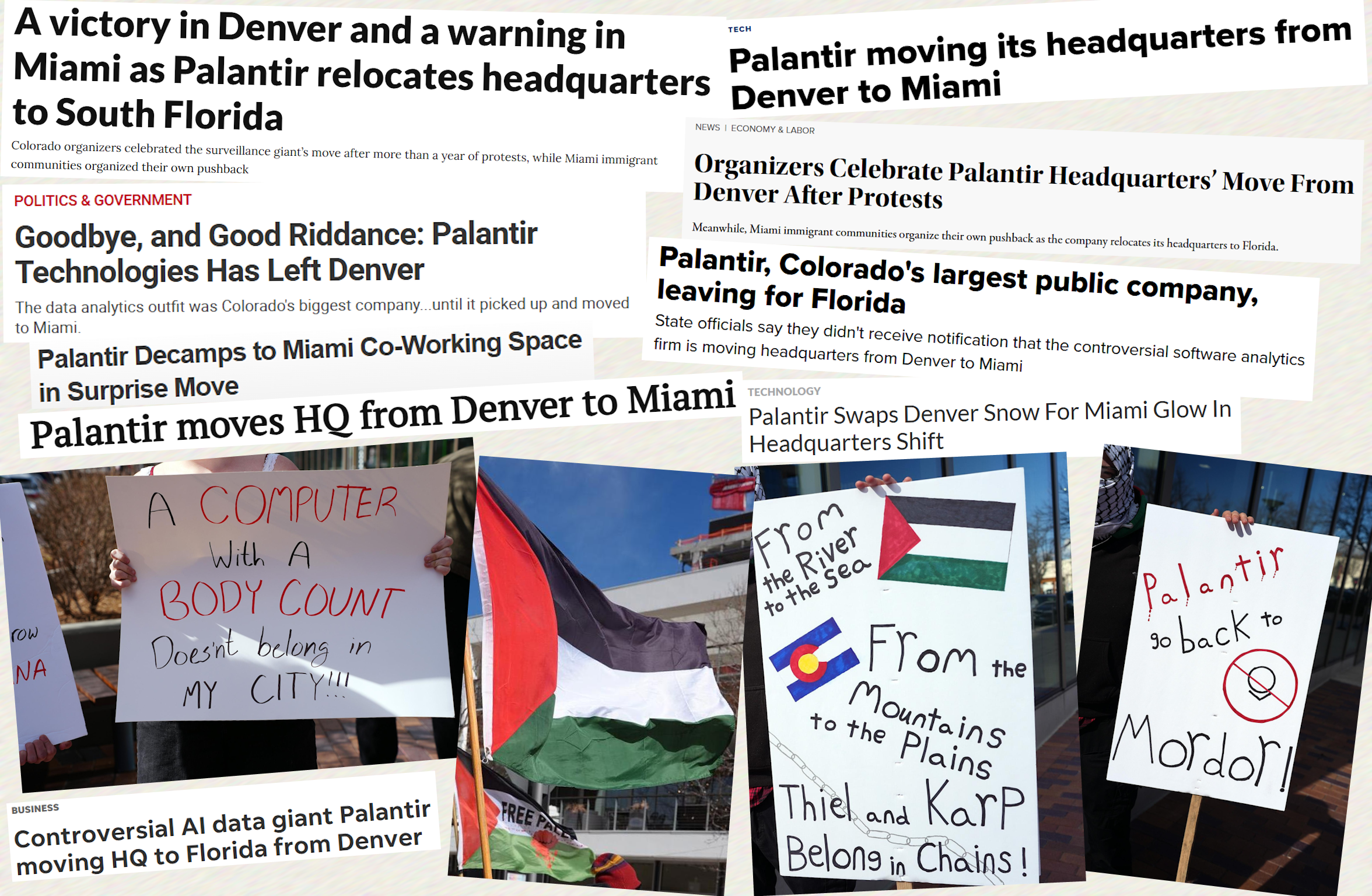
Thanks to consistent pressure from DAWA and many local organizations and community members, Palantir is in the process of moving their headquarters out of Denver! They announced this month they will be moving to Aventura, a community near Miami, Florida. DAWA is now working to grow our coalition to expel Palantir from this new location by connecting with other anti-war groups in Florida.
Additionally, as a co-founder of Denver Coalition Against Trump (DENCAT), a coalition with a diverse array of local organizations, DAWA remains committed to fighting Trump’s racist and reactionary agenda.
DAWA’s most recent events include:
- Palantir Out of Palestine rally at Cherry Creek – (Tuesday, 2/17/2026)
- Shareholder Meeting Emergency Disruption at Tabor Center – (Monday, 2/2/2026)
- Palantir Out – Rally and March to Cherry Creek Financial House – (Saturday, 1/31/2026)
- Palantir presentation at IPT’s “Colorado’s Unholy Trinity” event (Friday, 1/30/2026)
- Ice Out! – Emergency protest in response to ICE’s murder of Alex Pretti – (Sunday, 1/25/2026)
- DENCAT – “One Year is Enough” Rally (Saturday, 1/17/2026)
- Hands off Venezuela! Emergency protest in response to Trump’s bombing of Venezuela and kidnapping of President Nicolas Maduro – (Saturday, 1/3/2026)
Upcoming events include:
Keep reading to learn about why we are targeting Palantir, how we are adapting as they move out of state, how you can take action, and more!
Big Tech in Your Backyard: Palantir
Palantir, originally founded by Peter Thiel and Alex Karp, is a data analytics company that has continued to come under fire for its ties to the Trump administration, its work providing software to ICE, and more recently for their former ties to Jeffrey Epstein.
Despite public dissent against them, the company has seen massive growth from its work with the US government in both providing technologies that enable mass-surveillance within the United States and abroad. With this increased growth however has come increased notoriety, both from the rise in anti-ICE protests across the US, and due to the continued work put in by anti-war activists to highlight the threat that such companies pose.
Venezuela, Anthropic, and International Terror
Over the past few years AI has grown exponentially, leading to new struggles unfolding in all facets of life. While much of the conversation surrounding AI has focused on the environmental impacts and the threats to job security it poses, it has also become a major component in the United States’ reign of terror over the oppressed nations of the world. As was recently covered by Reuters, Anthropic’s AI model “Claude” was used in the illegal kidnapping of Venezuelan president Nicolás Maduro.
The operation, which was deemed by experts as a clear violation of international law, utilized Palantir’s partnership with Anthropic both in the planning and execution of the kidnapping. While the full scope of how it was utilized is still not fully known, its use led to dispute between Anthropic, Palantir, and the Pentagon. The conflict is centered around ethical concerns brought forth by Anthropic regarding the partnership, as the “Department of War” has begun to pressure the company into removing restrictions on their AI model: namely restrictions against mass surveillance technologies and autonomous weapons.
Surveillance Effects Everyone
In the US, Palantir’s continued partnership with ICE has been brought to the forefront of public attention in the wake of the massive protests against the agency. This partnership has let to the creation of an app for ICE which allows agents to create “maps” of potential targets. These maps are then used in all manner of ICE operations, ranging from the illegal seizure of people off the streets, to massive raids. Both operations are often performed without a warrant.
Such technologies impact everyone, and will continue to impact everyone as Palantir’s partnerships continue to allow them to slowly chip away at any semblance of privacy. In another recent example, the messaging app Discord has become a subject of criticism for its new age verification requirements, which would require users of the app to prove their age via government ID or face-scanning. The company has also provided a disclaimer that users’ data would be processed by Persona, an age verification vendor that has received investment funds from Peter Thiel.
Resistance to Palantir and to genocidal tech is right, just, and most of all necessary. Such resistance should be supported on the grounds of solidarity with those these companies terrorize first and foremost, but it is important to recognize as well that it is an issue that will continue to impact more and more people as surveillance begins to encroach on the personal lives of everyone. Sitting by idly shows these companies that they can keep pushing further without concern for backlash. When they push, we must push back.
Gains in the Fight Against Big Tech
As companies like Palantir continue to grow, as they continue to become a critical part of the US war machine and surveillance state, so too must the resistance against them become larger and louder. It is not enough to hope when it comes to big tech that there will be regulation or restriction against these companies, especially when the government itself is the one enabling them.
Across the world we have begun to see resistance against Palantir not only increase, but also put necessary pressure on both the corporations and the governments that contract with them. In the UK, for example, the government has begun to face increased pressure to halt contracts with Palantir. Similarly, a recent letter from CEO Alex Karp hints at protests against the company being a component in their decision to leave Denver for Florida.
The pressure from outside has led to increased dissent within the company as well, with slack messages provided to Wired showing that even employees at Palantir have begun to express concerns about the company and its activities.
The resistance against Palantir and similar companies provide another blow to the technologies fueling terror across the globe, from the ongoing occupation of Palestine, to increased US aggression against Iran and Venezuela, and the terror inflicted by ICE here in the US. Still, it is just one more strike in the ongoing fight. The more pressure we continue to put on these corporations—the harder we fight to ensure they don’t feel welcome anywhere—the more we put power back into the hands of the people.
Palestine Updates
Gaza
As of February 25th, 2026, after 868 days of ongoing genocide in Gaza, the IOF has murdered 72,082 Palestinians, with more bodies found under the rubble every day. In the month of January alone, Israel murdered over 100 Palestinians, despite the alleged “ceasefire” that has been in place since October 10.
On January 31, Israeli airstrikes across Southern Gaza killed over 31 people, including at least seven children. The strikes targeted residential areas, a police station, and a family tent in Khan Younis, killing seven members of the Abu Hadaid family. Israel has violated the ceasefire over 1,620 times, including the murder of 612 Palestinians in Gaza. Furthermore, only 43% of the agreed-upon aid trucks and 14% of the agreed-upon fuel has been permitted to enter Gaza.
On February 2, 2026, the Rafah Crossing between Gaza and Egypt partially reopened after being closed since May 2024 (excluding a brief opening during the January 2025 “ceasefire.”) Despite promises that 150 people could leave Gaza per day and that 50 people could enter per day, Gaza’s Government Media Office reported that between February 2 and February 18, there were only 640 departures and 508 arrivals. According to Gaza’s Health Ministry, there are over 20,000 people in need of urgent medical care. Palestinians allowed into Gaza report being subjected to hours-long interrogations, threats, and humiliation.
Trump’s “Board of Peace” outlined a 20-point plan to rebuild Gaza, but conditioned the reconstruction on the complete disarmament of resistance forces in Gaza, including light weapons. Despite false claims from Netanyahu, Hamas never agreed to disarmament in the ceasefire deal. Yet, Israeli Cabinet Secretary Yossi Fuchs, stated on February 16 that Hamas would soon have a 60-day window to give up their weapons or “the IDF will have to complete the mission.” Senior Hamas Official Basem Naim responded, stating “these light weapons in the hands of the Palestinian people are fundamentally for self-defense, not for aggression against anyone. Therefore, such a measure is rejected and cannot be allowed to pass, as they claim or demand.”
The “Board of Peace” also outlined plans for an International Stabilization Force (ISF), which plans to send thousands of troops to begin its operations in Rafah. Indonesia announced that it was preparing to send up to 8,000 troops but released a statement asserting that the ISF’s mandate is humanitarian in nature and that their participation “is not intended for combat missions and not for demilitarization missions.” Hamas has stated that it would welcome international forces only to serve as a neutral buffer between the resistance and the occupation, but not to perform security duties within Gaza.
West Bank
Conditions in the West Bank continue to worsen. Fourteen year old Mohammed Naasan was shot and killed by Israeli forces during a raid in Al Mughayyir village that took place as Palestinian residents were leaving mosques after Friday prayer.
Israeli forces stormed Birzeit University, located just North of Ramallah, in response to a student organized event in solidarity with Palestinian hostages held by Israel. At least 40 people were injured, including students and faculty after forces from 20 military jeepsbroke down the university’s main gate, fired live ammunition and threw stun grenades at the crowd.
Lawyers representing Beduoin communities in the Jerusalem governate town of Al Eizariya have been notified by Israeli authorities of their intention to begin construction on a road intending to reroute Palestinian traffic away from the planned E1 settlement expansion.
Israeli authorities have ordered the demolition of a football pitch in Bethlehem’s Aida refugee camp, claiming it lacks the proper Israeli building permits, which are nearly impossible for Palestinians to obtain. In the shadows of the West Bank separation wall, the pitch serves around 250 children every week and is in constant use.
Israeli settlers have repeatedly attacked water infrastructure in the Ein Samiya area, including breaking into well sites and destroying cables and a control panel, both key components of the water network. Settlers have erected metal fences and blocked roads leading to the wells. After being intimidated and threatened, maintenance staff were forced to leave the site, and attempts to return in order to repair the damage resulted in assault and injury by Israeli settlers on at least one Jerusalem Water Undertaking maintenance worker. The main water supply for at least 20 villages was cut off for three days, effecting about 100,000 Palestinians in Eastern Ramallah governate.
The Israeli government has approved a plan to restart land registration in area C of the West Bank. In effect, this would allow Israel to claim swaths of land as ‘state property’ shifting more than 62% of the West Bank from military administration into direct civilian authority. The move has been condemned as a massive land grab and effectively imposes annexation and Israeli sovereignty without having to formally declare it.
Venezuela Updates
On January 3, in a brazen violation of Venezuela’s sovereignty, US forces launched “Operation Absolute Resolve” to kidnap Venezuelan President Nicolás Maduro and his wife Cilia Flores from Fort Tiuna outside Caracas. The attack was condemned as a violation of international law by the EU, Brazil, Spain, France, Russia, China, and many others.
The kidnapping operation involved US law enforcement and special forces including Delta Force, as well as at least 150 aircraft launched from 20 different US bases. US forces cut power to Venezuela’s capital Caracas via cyberattacks on electricity infrastructure, and used similar means to deactivate Venezuelan air defense radar.US forces also reportedly used Anthropic’s Claude AI model during the raid through a contract with Palantir, though it is unclear exactly how the model was used. At least 24 Venezuelan soldiers were killed in the operation.
Maduro and Flores were transported to New York City aboard the USS Iwo Jima assault ship. Two days after the kidnapping, President Maduro and First Lady Flores were brought to federal court in Manhattan for arraignment. Prior to the hearing, Maduro and Flores were seen being transported off of a helicopter by DEA agents — likely a political display to associate them with the drug-trafficking charges leveled against them by Trump and his allies. Maduro affirmed before the judge that he was still the President of Venezuela and that he was a prisoner of war.
Venezuela’s government has been run by acting president and former Vice President Delcy Rodríguez since shortly after the abduction of President Maduro. Rodríguez has repeatedly condemned the kidnapping of Maduro and First Lady Flores, affirming that Maduro is the constitutional president of the country and calling for his and Flores’ return.
However, acting president Rodríguez and other Venezuelan officials have also been cooperating with the US government to various degrees. On January 16, CIA director John Ratcliffe traveled to Venezuela and held a two-hour meeting with Rodríguez. That same day, Rodríguez dismissed Maduro ally Alex Saab from his role as Industry Minister. More recently, Cuban security advisers and doctors have started leaving Venezuela. According to one source, they are leaving on the orders of Rodríguez due to pressure from the US for the country to break its historic ties with Cuba.
The Trump administration’s goal of forcing the privatization of Venezuela’s vast oil reserves and handing them off to US oil corporations has been the guiding force behind US government actions in Venezuela since January. On January 30, Venezuela’s National Assembly approved a wide-reaching reform to the country’s 2001 Hydrocarbon Law. The reform loosens restrictions on private ownership of the country’s oil resources, including lowering royalties and taxes placed on private oil firms by the Venezuelan government and granting operational and sales control to private contractors. The Trump administration reacted by significantly easing sanctions on Venezuela, giving several major oil firms license to operate in the country.
The extent to which Venezuela’s government remains sovereign remains to be seen. It is possible that Rodríguez is playing a delicate balancing game with the Trump administration. Rodríguez has managed to largely insulate the Venezuelan people from the effects of the US attack, and life in much of the country goes on as it did before. However, this is a dangerous game, as one can never strike a fair bargain with imperialism.
Anti-War Updates
Trump and US officials have been holding diplomatic talks with Iran while simultaneously building up a massive strike force within range of the country. Trump has claimed that rerouting the USS Gerald R Ford—the biggest aircraft carrier in the world which was used in the kidnapping of Venezuelan president, Nicolas Maduro—from the Caribbean Sea to the Middle East was “In case we don’t make a deal. We’ll need it.” The buildup is the biggest in the area since a 12 day bombing campaign in June that killed at least 1,000 people.
The US has blocked all oil shipments from entering Cuba, and has issued a threat of tariffs on any country who attempts to violate that block. The UN has warned that the island is undergoing a humanitarian collapse, with fuel shortages causing widespread power outages and a rise in prices for food and transportation. Cuban officials have announced a nationwide energy saving plan prioritizing health care, food and water supplies, and social services. Airlines have been notified by the Cuban government that they will be unable to refuel international flights, which comes as a major blow to tourism, a vital source of income for the island.
Wins
On February 17, after a year-long campaign from DAWA, local organizations, and community members, Palantir quietly announced that they had moved their headquarters from Denver to Miami. DAWA credits this move directly to the months of sustained pressure that we and our allies have put on Palantir at both the Tabor Center and the Cherry Creek Financial House. Palantir’s annual report, which was released last week, lists its risk factors, including the risk that its “reputation and business may be harmed by news or social media coverage or other external scrutiny of Palantir or [its] leadership.” The report expands on this point, stating that “activists have also engaged, and may continue to engage, in public protests at our properties and other locations.” This victory demonstrates that when the people unite against war-mongering, genocidal corporations, we win. Our sustained action including marches, rallies, teach-ins, flyering, and coalition building has led us to this moment. DAWA will continue to fight against any presence that Palantir attempts to maintain in our city. Furthermore, activists in Florida will take up the fight against Palantir, and our collective efforts will aim to push Palantir not only out of every city it attempts to take hold in but out of existence entirely.