
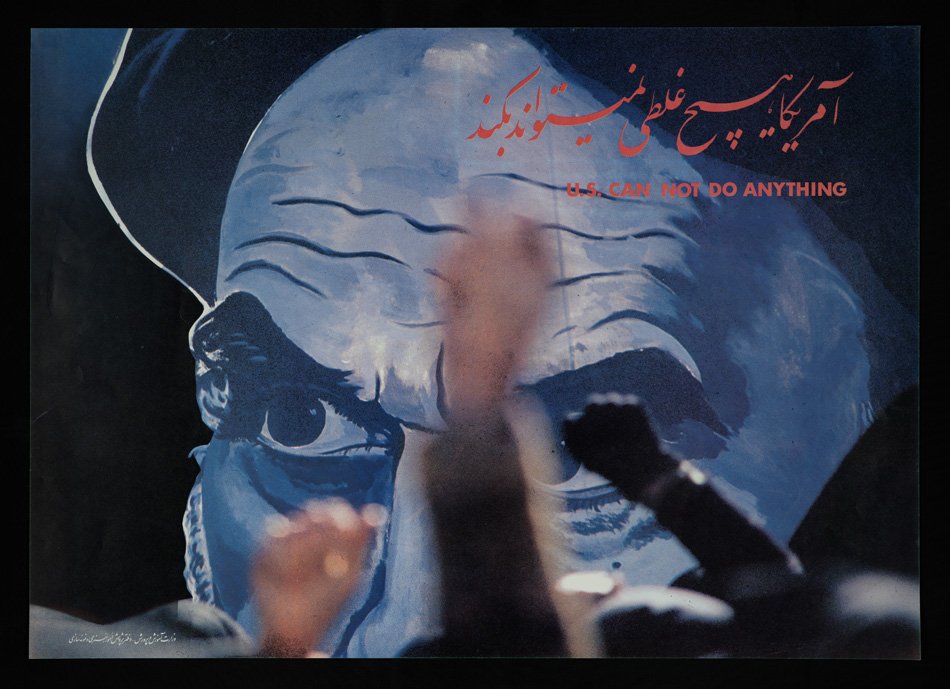
Iranian poster from 1980 featuring a portrait of Ayatollah Khomeini alongside a crowd of demonstrators. Red bilingual Persian and English text reads “The U.S. Can Not Do Anything.” (U. Chicago)
DAWA Updates
Denver Anti-War Action (DAWA) is a local community organization that opposes U.S. imperialism and the military-industrial complex worldwide. DAWA’s recent activity has largely focused on our campaign targeting Palantir, a software company with customers including the IOF (Israeli Occupation Forces) and ICE (Immigration and Customs Enforcement). However, DAWA continues to be in a transition phase following the win of Palantir moving their global headquarters out of Denver. Additionally, as a co-founder of Denver Coalition Against Trump (DENCAT), a coalition with a diverse array of local organizations, DAWA remains committed to fighting Trump’s racist and reactionary agenda. As a part of this, DAWA continues to devote energy opposing U.S. imperialism such as the Iran War and the blockade of Cuba.
Iran
On June 17th, the United States and the Islamic Republic of Iran signed and agreed to a 14 point “memorandum of understanding” (MoU) mediated by Pakistan. It calls for: an immediate and permanent end to all military operations on all fronts, including Lebanon; lifting of the US naval blockade on the Strait of Hormuz and Iran’s control over the Strait of Hormuz in cooperation with Oman; the US to pay Iran $300 billion for reconstruction; the lifting of all sanctions imposed on Iran and unfreezing of Iran’s assets, and Iran’s continued position that they do not want, nor plan to build, a nuclear weapon.
On June 25th, the Ever Lovely, a Singaporean commercial vessel, was damaged by unidentified drone strikes. Trump blamed Iran on X for striking the ship and called it a “foolish violation” of the ceasefire. Vance added that “we have honored [the ceasefire signed in the MoU]”, despite breaking previous ceasefires, and that “violence will be met with violence.” The US retaliated by striking several Iranian military storage locations and radar sites on its coast. In response, Iran struck US military outposts in the region.
Questions have also been brought up by the MoU’s vagueness on what Iran’s control over the Strait could look like. Iran has set up a shipping route closer to its shores for ships to sail. Oman and the International Maritime Organization have proposed alternate routes, like the one the Ever Lovely was taking, effectively leaving Iran out of talks about the Strait of Hormuz in violation of the agreed-upon terms. Iran has stated that vessels will need to work with the Islamic Revolutionary Guard Corps (IRGC) to pass through the waters, and unauthorized vessels have and will be warned to turn back.

Gaza
Israel has continued to violate the “ceasefire” in Gaza, with an upscale of attacks in June as the world focuses on Iran and Lebanon. Since the beginning of the supposed ceasefire in October, Israel has killed at least 1,053 Palestinians in Gaza and wounded 3,406, while 786 bodies have been found under the rubble. Homes in Gaza have been bulldozed, neighborhoods have been flooded with cement, and the deliberate targeting of children has continued, including strikes on several encampments and children walking home from school. Since October 7, 2023, the death toll has risen to 73,066, while 173,514 have been injured.
Imad Rajih Sarhan died of a heart attack in Israel’s Gilboa prison. After years of torture, medical neglect, and repeated solitary confinement left him with chronic heart conditions. He is the 90th recorded death in Israeli prisons since the start of the war in Gaza, and the 327th recorded death in Israeli prisons since 1967. Many rights groups describe Israel’s prison system as carrying out a slow execution policy through these methods. There are more than 10,000 Palestinians being detained in Israel, with almost 5,000 without charge or trial. Over 3,000 Palestinians have been detained by Israeli forces in 2026 alone.
All of this while more ceasefire negotiations started late June in Cairo, with Hamas delegates present in the proceedings. They hope to advocate for the end of the escalating Israeli violations in the Gaza strip, including the daily strikes and assassinations.
West Bank
Israeli authorities approved 576 new settlement units in the occupied West Bank, all illegal under international law. They are now allocating millions of dollars to members of the “Hilltop Youth”, who have killed at least 16 Palestinians in 2026 already. Under the new plan, Israel will be giving daily food and clothing vouchers worth about $15 per settler per day. Meanwhile, medicine shortages due to critical underfunding push the West Bank healthcare system towards collapse.
State-sactioned settler arson and terrorist attacks ravaged the West Bank. Israeli soldiers abducted Dr. Bilal Al-Shobaki, the head of the Political Science Department of Hebron University, and his parents Samira and Mahmod Al-Shobaki from their homes in the middle of the night. The next day, an Israeli soldier open fired into a family’s car, shooting 7-month old Sam Abu Haikal in the head, killing him and wounding both of his parents.
Dozens of Israeli settlers and an Israeli soldier stormed Huwara in a mob attack, wounding nine residents. The settlers beat residents, hurled stones, smashed vehicles and buildings, set fire to an auto repair shop, and stole livestock. The following day, Israeli forces raided and kidnapped individuals in Bethlehem, Tulkarem, and Husan with heavy machinery. They also used bulldozers to destroy the main water pipeline east of Tammun, cutting off water to families, livestock, and crops.
Israeli settlers doused a 92-year-old Palestinian man with gasoline through a mosque window in Deir Dibwan, set fire to Al-Nour Mosque in the nearby town of Burqa, and burned vehicles, agricultural fields, and an archaeological site. Israeli settlers set fire to and graffiti two mosques: one in Jaljilya and the other in Mazra’a al Nubani. Israeli forces and settlers later killed two teenage boys age 15 and 19 years old and injured two other young men in Best Ummar, north of Hebron and assaulted a 50-year-old woman during a raid on Kafr Qalil near Nablus.

Miner launches firecracker at La Paz police, AP News
Bolivia
In the aftermath of Trump’s attacks on Iran and the closing of the strait of Hormuz, the price of fuel across the world surged dramatically. In Bolivia, where tensions between workers and the “capitalism for all” government of Rodrigo Paz were already high due to last year’s fuel price hikes, the additional financial toll brought on by the Iran War became one of the sparks that fueled a wave of anti-government protests lasting for over 2 months.
The protests saw the nation’s economy come to a close as workers across a myriad of industries blocked roadways and halted production. Protestors demanded the resignation of Rodrigo Paz, and in the face of increasing suppression from the Bolivian state, continued to struggle, eventually forcing the government to sign a deal with the COB Labor Union.
Protests continued until Paz’s declaration of a state of emergency on June 21st, after which the blockades began to ease, but not disappear entirely, and even then only after achieving concessions from the government.

Delegates at the Third Extraordinary Session of Cuba’s National Assembly of People’s Power. (theleftchapter.com)
Cuba
June marked the sixth month of an intense tightening of the US-imposed economic blockade on Cuba. After losing key trading partners in the socialist Eastern Bloc in the late 1980s, Cuba made tourism a key pillar of its economy. This is why the Trump administration has specifically targeted Cuba’s tourism industry. US sanctions against Cuba’s state-owned business conglomerate GAESA forced international hotel chains Meliá and Iberostar to suspend contracts with Cuban companies in early June. Cuba’s government responded on June 5 with an announcement that it would permit private Cuban investors at home and abroad to manage hotels in the country.
Amid Cuba’s economic crisis imposed by the blockade, Cuba’s highest legislative body approved sweeping economic reforms on June 18 as a means to facilitate much-needed investment from abroad. The reforms, inspired by the economic models of China and Vietnam, comprise 176 measures. Among these are the allowing of private businesses with more than 100 employees, allowing individuals to hold shares in more than one company, extending land usage rights to medium-sized private enterprises, and the transition from a state-guaranteed basic food basket to retail sales without subsidies.
However, Cuba’s government emphasizes that socialist state-owned enterprises will “remain the fundamental pillar of the economy”. The basic food basket will still be guaranteed to retirees, families with chronically ill children, and other vulnerable people. All economic actors, including private companies, will be required to support services like soup kitchens, public health institutions, and various free services for the most vulnerable, at the local level.
On June 23, the US applied more coercive sanctions on five key Cuban enterprises including AUSA, Cuba’s main logistics and warehousing company. The US government also threatened to apply heavy secondary sanctions to any foreign bank or company that carries out transactions with the sanctioned entities.

Rendering of Voyager American Defense Complex to be constructed near Pueblo, CO. (Gazette)
Big Tech in Your Backyard
Voyager
Voyager Technologies is a space holding company seeking to broaden its capabilities to match space “primes” like SpaceX and Rocket Lab by buying up smaller companies. Headquartered at 1225 17th St in Denver, Voyager operates in industries from hypersonic weapons to electronic warfare.
Voyager has acquired 13 companies since 2020. Four are located in Colorado. Voyager Energetics, headquartered outside of Pueblo, specializes in technology supporting missiles and tactical munitions. Voyager Energetics is the only US manufacturer of black powder, which is used as an igniter in solid rocket motors and related military technologies. Voyager Energetics is also working on a DARPA Burn and Go contract, which aims to develop a versatile solid rocket motor for use across multiple weapons systems.
Littleton-based ExoTerra Resource produces electric propulsion systems in the form of Hall-effect thrusters and associated modules. ExoTerra was acquired by Voyager last November and supplies propulsion systems for Space Development Agency (SDA) missile defense satellite constellations as well as for Israeli Aerospace Industries (IAI). Other Voyager subsidiaries in Colorado include BridgeComm, Inc. and Pioneer.
One of Voyager’s latest projects is the Voyager American Defense Complex, set to open in Pueblo later this year. The 150,000 square-foot facility will manufacture propulsion technologies to support the aforementioned Burn and Go contract. Additionally, Voyager is leading a joint venture to develop a privately owned space station, named Starlab, as part of a partnership involving Voyager, Northrop Grumman, Palantir, and others.
Voyager is among the largest of the new generation of defense corporations seeking to dethrone ossified giants like Lockheed and Boeing. Led by CEO Dylan Taylor, whose cultivated self-image borders on a personality cult (his personal website even includes a section for his quotations), Voyager seeks to become an invaluable asset for the US war machine in the coming years.
Wins
Australia, the UK, France, Norway, Canada and New Zealand imposed coordinated sanctions on networks that enable and fund settler violence in the West Bank. France has also banned Israeli Finance Minister Bezalel Smotrich along with a number of settlers and leaders of settler groups from entering the country.
The Norweigian government has announced the proposal of a bill seeking to ban trade with Israeli settlements on occupied Palestinian land. They also plan on banning the purchase of any property in these areas.
Two incumbents in the New York congressional primary heavily funded by AIPAC were ousted by Mamdani endorsed progressives. This continues the growing trend of Americans looking for representatives who stand up for workers and stand against Israel. AIPAC spent over $2 million on their candidates.
Ireland has banned Israel’s National Security Minister, Itamar Ben-Gvir and Finance Minister, Bezalel Smotrich, from entering the country. Ireland’s Prime Minister Micheal Martin cited their stances against pro-Palestinian activists and support for Palestinian displacement.

Help those facing ICE oppression, support the Sanctuary 4 All Legal & Mutual Aid Fund!